Intuition
To show a sequence does not converge to a number, deny the definition. Each quantifier turns over: instead of every tolerance being answerable, one tolerance is not; instead of a place beyond which the terms behave, every place is followed by a term that misbehaves. Naming that one stubborn tolerance is the whole proof.
Back to the challenge. To win as the challenger you do not have to defeat every answer; you have to name a single margin your opponent can never meet, and then, wherever they point in the list, produce a later term outside it.
Denying the definition
This is the negation of a statement with three nested quantifiers, done exactly as the chapter on logic set out. Each quantifier flips as the negation moves inward, and the inequality reverses at the end.
What each flip means
- One tolerance is enough. You choose it, and it may be as convenient as you like.
- It must defeat every place, so the argument has to work for an arbitrary .
- For that you produce one later term outside the tolerance, not all of them.
- A sequence that converges to no number at all is called divergent.
- means: for every there is an with for all . Such a sequence diverges — the notation records how, and does not name a limit.
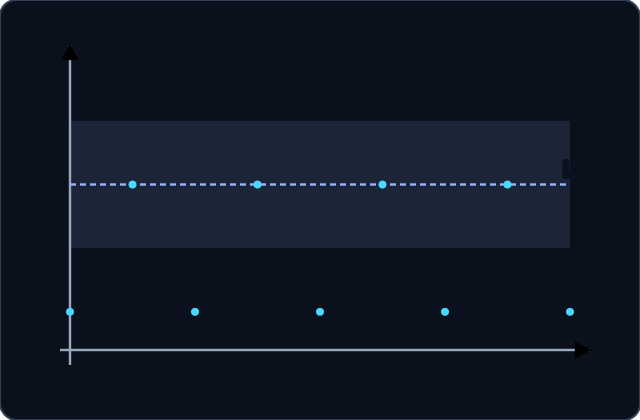
Here and , the value it keeps returning to. Take : wherever you point in the list, a term at comes later, a distance 2 away. One tolerance with no answer is the whole denial — and no other choice of escapes it, since some term is always at least 1 away.
The alternating sequence has no limit
Suppose a limit existed. With a tolerance of one, terms of both signs would have to lie within one of it, and the triangle inequality then squeezes the distance between those two terms below its own value.
Proof steps
Assume a limit exists and drive it to an impossibility.
One tolerance is all the denial needs, and this one is convenient.
This is what convergence would give for that tolerance.
Even places give one, odd places give minus one, and both kinds occur forever.
The triangle inequality routes the distance between the two terms through .
The supposition produced a contradiction and must be rejected.
Applications
Practice
Every quantifier flips
Three flips, then the condition inside is denied.
Try it
What is the negation of ?
One stubborn tolerance suffices
For , taking is enough.
Terms one apart cannot both lie within one of the same number.
Try it
To show , how many tolerances must you handle?
The place is not yours to choose
The place was handed over, and a misbehaving term was produced beyond it.
Try it
In a proof that a sequence does not converge, who chooses the place ?
Divergent is not the same as unbounded
is bounded and divergent.
It never leaves the range from minus one to one, and it never settles either.
Try it
Which statement is true?
Try it
In the proof that has no limit, what does the triangle inequality do?
Diverging to Infinity
A sequence can fail to converge in an orderly way. The notation says how it fails, not that it has a limit.
Try it
What does mean?
Try it
A divergent sequence must be unbounded.
Try it
To show that does not converge to , which tolerance works?
Try it
For , and , how many terms satisfy ?
What You Learned
- To deny convergence, produce one tolerance that defeats every place.
- The place is your opponent’s: the argument must work for an arbitrary N.
- For that place you produce one later escaping term, not all of them.
- Divergence to infinity is a way of failing, not a limit.
Final checkpoint
Try it
In a proof that , the place is chosen by the person writing the proof.
Completion
Lesson complete
Great work! You now know how to:
- Negate the definition of a limit and use the result
- Choose one convenient tolerance and defeat an arbitrary place
- Tell divergence from unboundedness, and read the arrow to infinity correctly