Intuition
A subsequence is what is left when terms are struck out, provided infinitely many survive and their order is kept. Two facts make the idea powerful. A convergent sequence drags every subsequence to the same limit, so two subsequences with different limits prove a sequence diverges. And every bounded sequence, however badly it behaves, has at least one subsequence that does converge — which is the deepest theorem of the chapter and the one the rest of the course leans on.
A crowd wanders about inside a field. Nobody need be heading anywhere, but if you halve the field and keep the half holding infinitely many people, and halve again, and again, you close in on a spot with people arbitrarily near it. Choose one person from each stage and you have picked out a procession heading somewhere, out of a crowd that was not.
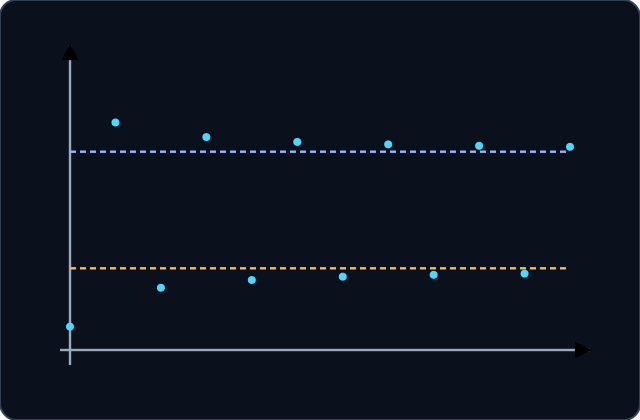
The terms settle nowhere. The even-numbered ones fall onto the upper level, at , and the odd-numbered ones rise to the lower level, at : each is a subsequence with a limit of its own, and two different subsequential limits are exactly what divergence looks like here.
Striking out terms, and what survives
Given and indices , the sequence is a subsequence. Because the indices are strictly increasing naturals, for every , and that inequality is what every proof about subsequences uses. A number is a subsequential limit of when some subsequence converges to it.
The three facts
- If then for every subsequence: the tail of the subsequence sits inside the tail of the sequence, because .
Bolzano–Weierstrass
Trap the sequence in an interval and halve it repeatedly, each time keeping a half that still holds infinitely many terms — at least one half must, since the whole does. The halves form a nest of closed bounded intervals, so they share a point. Pick one term from each stage, always with a later index than the last, which is possible because each stage holds infinitely many terms. Those chosen terms are a subsequence, and they are squeezed onto the common point because the stages shrink to nothing.
Proof steps
Boundedness puts every term inside one closed interval.
If both halves held finitely many, so would the whole, so at least one half qualifies.
Nested closed bounded intervals whose lengths shrink to zero meet in exactly one point.
Each stage holds infinitely many terms, so one with a later index than the last can always be chosen.
Both the chosen term and the common point lie in the kth interval, so the distance is at most its length.
Applications
Practice
Striking Out, Keeping Order
A subsequence keeps infinitely many terms and never reorders them.
Try it
Which of these is a subsequence of ?
Try it
Every subsequence satisfies .
Try it
If , what happens to a subsequence ?
Two Limits, No Limit
The quickest divergence proof there is: exhibit two subsequences settling in different places.
Try it
Which pair of subsequences shows that diverges?
Try it
Every sequence has a convergent subsequence.
Try it
In the bisection proof, why must one of the two halves hold infinitely many terms?
Try it
How many subsequential limits does the sequence have?
Try it
A bounded sequence has exactly one subsequential limit . What follows?
What You Learned
- A subsequence keeps infinitely many terms in order, and .
- A convergent sequence drags every subsequence to its limit.
- Two subsequential limits prove divergence.
- Every bounded sequence has a convergent subsequence, and unboundedness is the only obstruction.
Final checkpoint
Try it
Bolzano–Weierstrass tells you which subsequence converges.
Try it
Which sequence has no convergent subsequence?
Completion
Lesson complete
Great work! You now know how to:
- Say what a subsequence is and why its indices satisfy a useful inequality
- Prove divergence by exhibiting two subsequential limits
- State Bolzano–Weierstrass and run its bisection proof
- Say what the theorem gives and what it withholds