Intuition
A sequence cannot settle towards two different numbers. The reason is geometric: two different numbers have a gap between them, and if the terms were eventually within half that gap of each one, they would have to be in two places at once. The proof turns that picture into three lines, and it is the first place in the course where the tolerance is chosen to fit the problem rather than taken as given.
A ship cannot dock at two harbours a mile apart. If it is eventually within a hundred metres of each, it is in two places at once. And a ship that docks was never at unlimited distance: it spent all but the start of its voyage near the harbour.
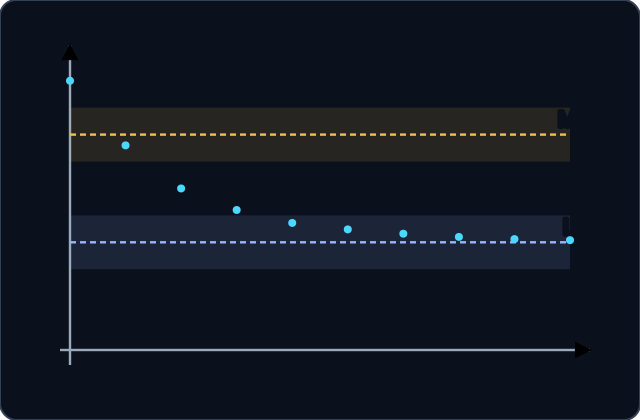
Take any below half the gap between and and the two bands come apart, as they have here. A term beyond both places would have to be in both bands at once, and between them there is nothing — so a sequence has at most one limit.
One limit, and why the tolerance is chosen
Suppose a sequence converged to two different numbers. Apply the definition to each, at a tolerance small enough that the two bands cannot overlap — half the distance between them does it — and a term past both places is inside both bands at once. The triangle inequality then produces a number strictly less than itself.
The two facts
- A convergent sequence has exactly one limit, so the notation names a single number.
- Half the distance between the two candidates is what makes the bands disjoint; a third or a quarter of it would serve equally well.
- The proof is by contradiction, and the absurdity is a positive number strictly below itself.
- It uses no completeness: uniqueness of limits holds in as well, and indeed wherever distance obeys the triangle inequality.
A sequence has at most one limit
Suppose the two candidates differ. Take the tolerance to be half the gap between them. Far enough along, the terms are within that of both, and the triangle inequality then makes the gap smaller than itself.
Proof steps
Assume two different limits and drive it to an impossibility.
The gap is not zero, so half of it is a legitimate tolerance.
Each limit supplies a place; take the later of the two.
The triangle inequality routes the gap through a term of the sequence.
Both distances are under the tolerance, and two halves make the whole.
The supposition that the limits differ cannot stand.
Applications
Practice
Half the gap is the useful tolerance
Two such tolerances sum to the very distance being bounded, which is what makes it beat itself.
Try it
Why is the tolerance taken to be half the distance between the two candidate limits?
:::note{title="Why "the" limit is allowed"} Naming a single value only makes sense once uniqueness is known. That is what this lesson buys. :::
Why "the" limit is allowed
This notation names one number, which uniqueness is what justifies.
Try it
What does uniqueness of limits justify?
Try it
The uniqueness proof is by which method?
A Number Below Itself
The contradiction is not a false arithmetic fact plucked from nowhere; it is the gap being shown to be smaller than itself.
Try it
What absurdity does the uniqueness proof reach?
Try it
The uniqueness of limits needs the completeness axiom.
Try it
Two candidate limits are and . Which tolerance makes the two bands disjoint?
Try it
Two candidate limits are and . What tolerance does the proof take?
What You Learned
- A sequence has at most one limit, so the phrase "the limit" is justified.
- The tolerance is chosen as half the gap so the two bands cannot overlap.
- The proof is by contradiction, and the absurdity is a number below itself.
- No completeness is used, so uniqueness holds in the rationals too.
Final checkpoint
Try it
Writing for a convergent sequence is justified by this theorem.
Completion
Lesson complete
Great work! You now know how to:
- Prove that a limit is unique
- Choose a tolerance to fit the problem rather than waiting to be given one
- Say why the notation for a limit is well defined