Intuition
A sequence converges to a number when its terms eventually stay as close to it as anyone cares to demand. The demand comes first: name a tolerance, however small, and the sequence must reach a place beyond which every term lies within that tolerance. A tighter demand may need a later place, and that is allowed.
Treat it as a challenge with two players. You name a margin of error. I must point to a place in the list beyond which every term is inside your margin. If I can answer every margin you name, the sequence converges. If there is one margin I can never answer, it does not.
The definition of a limit
Three quantifiers, and the whole content is in their order. The tolerance is given first, the place is chosen second and may depend on it, and the condition must then hold at every later place.
Reading it in order
- is the tolerance and it comes first, so nothing may be chosen in advance to suit it.
- is chosen after and is allowed to depend on it. A smaller tolerance usually needs a larger .
- Every term from onwards must be inside the tolerance. Terms before may do anything at all.
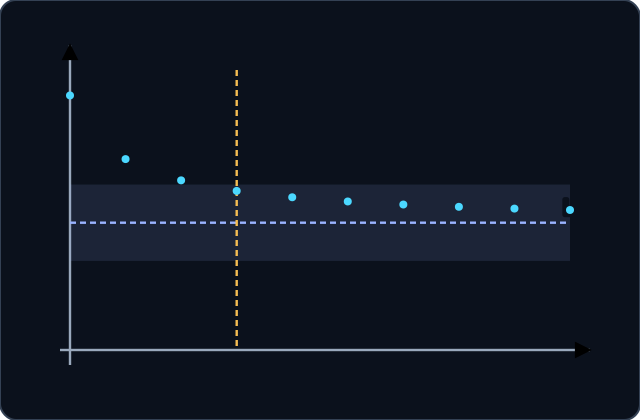
Here and . The tolerance is named first — the band is — and only then must a place exist beyond which term lies inside it. Narrow the band and slides right, which the definition allows; what it forbids is a band that no answers.
The reciprocals converge to zero
Take the tolerance as given, and use the Archimedean property to find a place whose reciprocal is already below it. From that place onwards the terms only get smaller, so they stay below.
Proof steps
The tolerance is named first, and nothing may be chosen before it.
The Archimedean property supplies such an ; this is the move that chapter promised.
Now take any place at or beyond the one just chosen.
The terms are positive, and a larger index gives a smaller reciprocal.
Chaining with the choice of puts the term inside the tolerance.
Every challenge was answered, which is exactly what the definition asks.
Applications
Practice
The tolerance comes first
Reading left to right: for any tolerance, there is a place, beyond which every term behaves.
Try it
In the definition of a limit, which is chosen first?
A tighter tolerance may need a later place
For : needs , and needs .
A smaller tolerance pushed the place further along, exactly as the order of the quantifiers allows.
Try it
May the place depend on the tolerance ?
It must stay inside, not merely visit
takes the value infinitely often, yet does not converge to .
It returns to forever without ever staying there, and the definition asks it to stay.
Try it
A sequence comes within of infinitely often but also leaves that range infinitely often. Does it converge to ?
The early terms are free
Three wild terms at the front change nothing, because may be chosen past them.
Try it
Changing the first thousand terms of a convergent sequence does what to its limit?
Try it
To prove directly, what must you produce?
All But Finitely Many
The definition says the same thing as a statement about how many terms can escape.
Try it
Which statement is equivalent to ?
Try it
holds exactly when .
Try it
converges to , and no term equals . Is that a problem?
Try it
For and , what is the smallest place such that every term from on is within of ?
What You Learned
- The tolerance comes first; the place is chosen after it and may depend on it.
- Every term from the place onwards must be inside the tolerance, and earlier terms are free.
- Equivalently: every band around the limit holds all but finitely many terms.
- A limit need not be attained, and usually is not.
Final checkpoint
Try it
If a single place worked for every tolerance , the sequence would have to be constant from on.
Completion
Lesson complete
Great work! You now know how to:
- State the definition with its three quantifiers in the right order
- Read convergence as all but finitely many terms in every band
- Say why a limit need not be attained