Intuition
Limits survive arithmetic. If two sequences settle, so do their sum, their difference and their product, and each settles where you would hope. Division needs one extra care: the sequence you divide by must not settle at zero. These rules are what let a complicated limit be broken into pieces.
Two travellers each approach their own meeting point. Their combined position approaches the combined point, because once each is close, the pair is close. Only division is delicate, and for the reason division is always delicate.
The algebra of limits
Each rule is proved the same way: split the tolerance between the pieces so that the parts add up to what was asked. Halving is the usual split, and the pattern is worth recognising because it recurs everywhere.
The rules
- Sums and differences: .
- Products: , and for a constant .
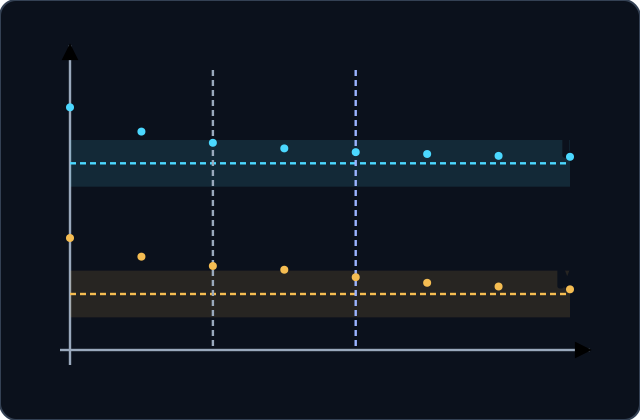
The trick of the proof, drawn. Ask each sequence for half the tolerance — both bands are tall — and then take the later of the two places, . Beyond it both hold at once, and the triangle inequality adds the halves back to the that was asked for.
The limit of a sum
Ask each sequence for half the tolerance. Beyond the later of the two places both halves hold at once, and the triangle inequality adds them back to the whole.
Proof steps
As always, the tolerance is named first.
Half the tolerance is itself a legitimate tolerance to demand of the first sequence.
The same demand of the second sequence.
Beyond the later place both conditions hold at once.
Regroup, then apply the triangle inequality.
The two halves add back to the tolerance that was asked for.
Applications
Practice
Split the tolerance
Demanding half of each leaves exactly the tolerance that was asked for.
Try it
In the proof for a sum, what tolerance is demanded of each sequence?
Take the later place
Past this point neither condition has lapsed, which is what the argument needs.
Try it
Why is taken to be the larger of the two places?
Division needs a non-zero limit
both tend to , while .
Both settle at zero and their quotient runs off without limit.
Try it
When may you conclude ?
Breaking a limit into pieces
The constant stays, the reciprocal part tends to zero, and the sum rule joins them.
Try it
What is the limit of ?
Try it
The rules combine limits of and . What must be true first?
Order Survives, Strictness Does Not
A weak inequality between terms gives a weak inequality between limits. A strict one gives only a weak one.
Try it
for every , and . What follows?
The Squeeze
Trap an awkward sequence between two that are easy, and if the two settle at the same place so must it.
Try it
What is ?
Try it
If and then converges to .
Try it
What is ?
What You Learned
- Sums, differences, products and constant multiples of convergent sequences converge to the obvious things.
- Quotients need the limit of the denominator to be non-zero.
- Weak inequalities survive the limit; strict ones do not.
- The squeeze theorem handles a sequence by trapping it between two that are easier.
Final checkpoint
Try it
may converge even when neither nor does.
Completion
Lesson complete
Great work! You now know how to:
- Apply the rules for sums, products, constants and quotients
- Name the hypothesis the quotient rule needs
- Pass a weak inequality to the limit, and say why a strict one is lost
- Use the squeeze theorem on a sequence that resists the rules