Intuition
A sequence that settles cannot run away, and the proof has a shape worth learning because it is used again and again: the definition controls the tail, a finite list is handled by taking a maximum, and the two are put together. The converse is false, and the sequence that shows it is the one from the last lesson — bounded, and settling nowhere.
A ship that has entered harbour for good is somewhere on the chart. The definition says it is inside the harbour from some day onwards, which handles all but finitely many days; the days before that are a finite list, and a finite list has a farthest point. The chart is then drawn to cover both.
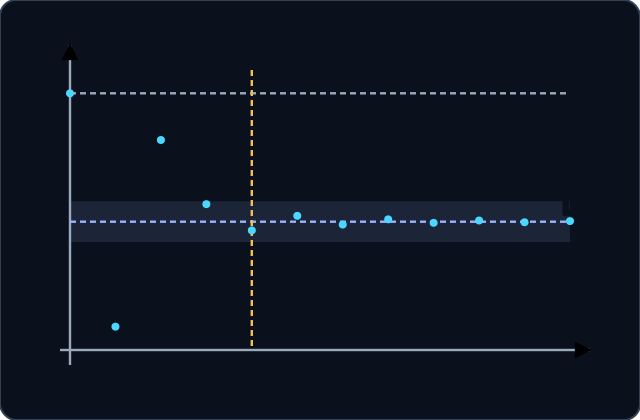
From on, the terms are within one of the limit, so their size is at most . Before there are finitely many terms, and a finite list has a largest size. The bound is the larger of the two.
The theorem, and the shape of its proof
If then there is an with for every . The proof applies the definition once, at the convenient tolerance , and then handles the finitely many early terms separately. The converse fails, so boundedness is a necessary condition for convergence and not a sufficient one — which makes its contrapositive the quickest test for divergence there is.
How it is used
- The contrapositive is the working form: an unbounded sequence converges to nothing. , and all diverge for this reason alone.
A convergent sequence is bounded
Use the definition once, at a tolerance chosen for convenience rather than because anything demands it. With the tolerance equal to one, every term past some place lies within one of the limit, so the size of each is at most the size of the limit plus one. That leaves only the terms before that place, and there are finitely many of them, so their sizes have a largest. The bound is whichever of the two numbers is larger.
Proof steps
Any fixed tolerance would do; one is convenient.
The definition controls every term from some place onwards.
The triangle inequality turns closeness to L into a bound on the size.
The remaining terms are a finite list, so their sizes have a largest.
Whichever of the two is larger bounds both parts at once.
Applications
Practice
Choose the Tolerance Yourself
When the definition is being used rather than verified, the tolerance is yours to pick. Pick one that makes the arithmetic easy.
Try it
Why is the tolerance taken to be in the proof?
Try it
Why can the terms before the place be dealt with by taking a maximum?
Try it
Every bounded sequence converges.
Try it
Which sequence can be shown to diverge by this theorem alone?
Try it
For , which converges to , what is the smallest integer with for every ?
Try it
An unbounded sequence has no limit.
A Limit Is a Statement About the Tail
Changing finitely many terms changes no limit, and changing them cannot break boundedness either.
Try it
A convergent sequence has its first terms replaced by . What happens?
What You Learned
- A convergent sequence is bounded, and the proof controls the tail and then the finite front.
- The converse is false, and the alternating sequence shows it.
- The contrapositive is the quickest test for divergence.
- Both convergence and boundedness survive a change to finitely many terms.
Final checkpoint
Try it
Which statement about boundedness and limits is true?
Try it
The proof would still work if the maximum were taken over all the terms rather than over the finitely many before the place.
Completion
Lesson complete
Great work! You now know how to:
- Prove that a convergent sequence is bounded
- Use the contrapositive as a test for divergence
- Say why the finite front must be separated from the tail
- Give a bounded sequence with no limit