Intuition
A bounded sequence need not have a limit, but it always has two numbers that behave almost as well. Look at the tail from the nth place on and take its supremum; as n grows that supremum can only fall, and a falling sequence bounded below settles. What it settles at is the upper limit, and the mirror construction gives the lower one. They always exist, they trap the sequence, and they are equal exactly when the sequence converges.
Watch a share price and ask each day for the highest it will ever reach from today onwards. That ceiling can only come down as days pass, because each day removes a possibility. What it comes down to is the upper limit: the highest level the price keeps returning near, as opposed to the highest it ever reached.
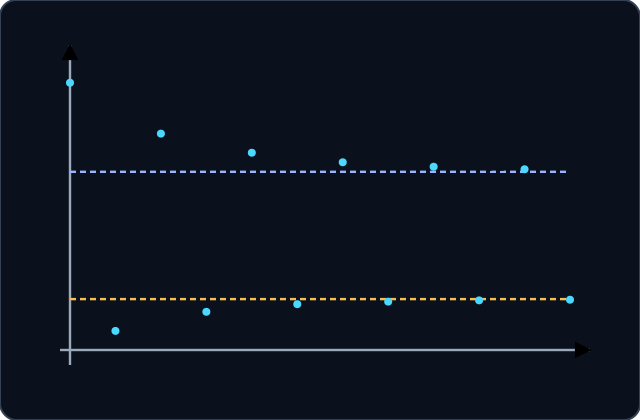
The terms keep returning near the upper level, at , and near the lower one, at , and settle at neither. The upper limit is the larger of the two levels a sequence keeps coming back to and the lower limit is the smaller, and the gap between them is exactly what stops this sequence converging.
Two limits that always exist
For a bounded sequence put and . Then decreases and increases, both are bounded, and both converge by monotone convergence. Their limits are and . Unlike the limit, these exist for every bounded sequence, and always.
What they are good for
- converges exactly when , and the common value is the limit.
Convergence is the two limits agreeing
Each direction is read off the definitions. If the sequence converges then past some place every term is within the tolerance of the limit, so the supremum and the infimum of that tail are both within it too, and two numbers trapped inside every band around L must both be L. Conversely, if the two agree then the tail supremum and the tail infimum both approach the common value, and every term lies between them, so the terms are squeezed onto it.
Proof steps
Start from convergence and take an arbitrary tolerance.
The whole tail sits in the band, so its infimum and supremum do as well.
Both are trapped within every band around L, so both equal it.
Assume the two agree; the tail infima and suprema both converge to the common value.
Every term lies between the infimum and the supremum of its own tail, so it is squeezed.
Applications
Practice
The Ceiling Over the Tail
Take the supremum of what is left from the nth place on. As n grows the tail shrinks, so that supremum can only fall.
Try it
Why does , the sequence of tail suprema, converge for a bounded sequence?
Try it
What is ?
Try it
Every bounded sequence has an upper limit and a lower limit.
Try it
When does a bounded sequence converge?
Try it
What is of the sequence ?
Try it
The upper limit is the largest subsequential limit.
Only an Inequality
The upper limit of a sum need not be the sum of the upper limits.
Try it
Take and . What are and ?
What You Learned
- The tail suprema decrease and the tail infima increase, so both converge for a bounded sequence.
- The two limits always exist, and they are the largest and smallest subsequential limits.
- A sequence converges exactly when they agree.
- For sums only an inequality holds, and it can be strict.
Final checkpoint
Try it
Why is it worth stating a result about bounded sequences with the upper limit rather than the limit?
Try it
for every bounded sequence.
Completion
Lesson complete
Great work! You now know how to:
- Build the tail suprema and infima and say why each converges
- Compute both limits for a sequence that does not converge
- Use their equality as a convergence criterion
- Say why the tests of the next chapter are stated with the upper limit