Intuition
Knowing the definition and being able to use it are different skills, and this lesson is about the second. Every proof that a sequence converges has the same four lines, and the only thinking happens between the second and the third: given a tolerance, find a place. The work of finding it is done on scratch paper by solving an inequality, and the proof that gets written down runs the other way, from the choice to the conclusion.
A recipe for answering a challenge. The challenger names a tolerance; you must name a place. You work out which places would do by solving the inequality backwards, then present the answer forwards, as though you had known the place all along. Nobody is expected to guess it — but nobody shows the guessing either.
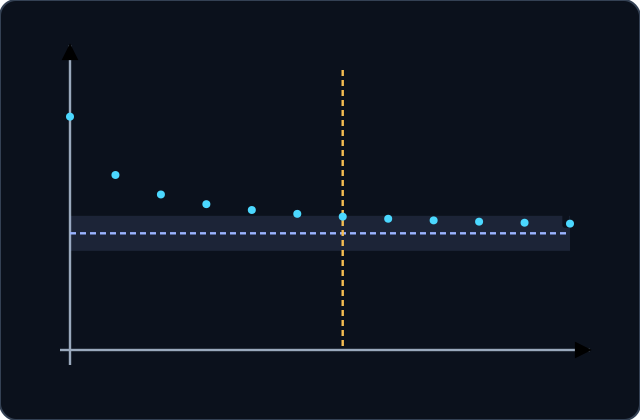
A tolerance is named first and draws the band; the place is then chosen so that every term from there on is inside it. A tighter band would push to the right, and the proof has to say how far.
The four lines, and the work between them
A proof that has the shape: let be given; choose ; let ; show . The choice of is found beforehand by solving for , which is scratch work and is not part of the proof. Any that works is acceptable — there is no need for the smallest one — and the Archimedean property is what guarantees one exists.
The moves that keep appearing
- Simplify into a single fraction first; the whole difficulty is usually algebra rather than analysis.
- Over-estimating is allowed and usually wise: if then works, and the cruder bound is easier to solve.
A worked limit
Simplify the difference first: it collapses to a single fraction, and the whole proof is then about making that fraction small. The Archimedean property supplies a place at which one over the index is already below the tolerance, and from that place on the fraction only shrinks. Write the four lines in order and the argument is complete; the solving that found the place belongs on scratch paper.
Proof steps
The tolerance comes first and nothing may be chosen in advance to suit it.
Simplify the difference into a single fraction; this is where the algebra happens.
The Archimedean property supplies such an N, and any larger one would do as well.
Later terms have smaller reciprocals, so the bound at N carries to every term past it.
Which is the definition, for the tolerance given — and the tolerance was arbitrary.
Applications
Practice
The Four Lines
Every proof of a limit has this shape, and only the third line takes thought.
- Let a tolerance be given.
- Choose a place, using the Archimedean property.
- Take any index at or past that place.
- Show the distance is below the tolerance.
Try it
Which line opens a proof that ?
Try it
To prove , which choice of works for a given ?
Try it
For and , what is the smallest with for every ?
Try it
A proof of convergence must produce the smallest place that works.
Where the N Comes From
Nothing in the algebra produces a natural number. The Archimedean property does.
Try it
Which fact guarantees that a place with exists?
Try it
To prove , what is ?
Try it
If then for every .
Try it
For the constant sequence and any , what is the smallest place that works in the definition of ?
What You Learned
- The tolerance is given first; the place is chosen afterwards and may depend on it.
- Simplify the difference into one fraction, then over-estimate it if that makes the solving easier.
- Any working place proves the claim; the smallest is never required.
- turns the bound at into a bound at every later index.
Final checkpoint
Try it
A student writes: "Take . Then for every and every , ." What is wrong?
Try it
Solving for is scratch work rather than part of the finished proof.
Completion
Lesson complete
Great work! You now know how to:
- Write the four lines of an epsilon–N proof in order
- Simplify a difference and solve for the place on scratch paper
- Over-estimate deliberately to make the choice easier
- Say why the place may depend on the tolerance and not the other way round