Intuition
Here completeness earns its keep. A sequence that only rises, and never passes some ceiling, has to settle somewhere, and the place it settles is the least such ceiling. Nothing about the terms tells you what that number is; the supremum is what produces it. This is the first theorem of the course that could not be proved without the completeness axiom.
A rising tide under a fixed ceiling cannot rise for ever and cannot stop short of the highest level it reaches. That highest level need not be a level the tide ever attains, which is exactly why the supremum, rather than a maximum, is the right notion.
The monotone convergence theorem
The hypothesis is easy to check and the conclusion is strong: convergence, with the limit named. Compare it with the definition, which requires the limit to be known before it can be tested.
What it does and does not need
- Both hypotheses are needed: is increasing and unbounded, and is bounded and not monotone.
- The mirror statement holds for a decreasing sequence bounded below, with the infimum as the limit.
- The theorem names the limit without computing any term, which is what makes it so useful.
- It rests on completeness, so it fails in : a rising sequence of rationals can press towards a gap.
- A recursive sequence is usually handled by proving monotonicity and a bound by induction, then taking limits in the recursion to identify the value.
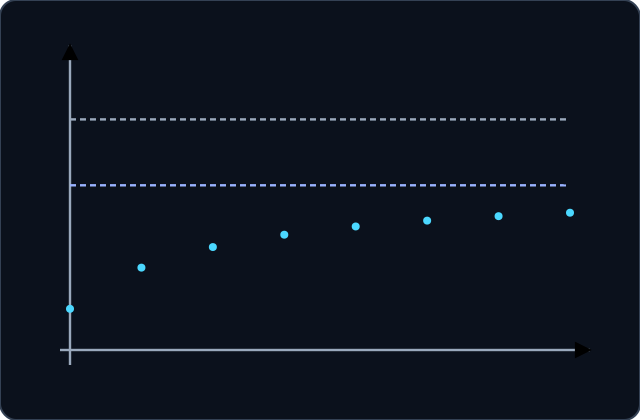
Here rises and never passes a ceiling, so it has to settle — and it settles at the least ceiling. The upper line is a bound as well; the supremum is the sharpest one, and it is never a term of this sequence, which is exactly why a maximum would not serve. Completeness is what guarantees it exists.
An increasing sequence bounded above converges
Completeness turns the set of terms into a single number, its supremum. Anything below that number fails to be an upper bound, so some term already passes it, and from there the sequence only rises while staying under the supremum.
Proof steps
This is completeness, and it is the only place the axiom is used.
Now the definition of a limit is to be verified against that number.
The supremum is least among upper bounds, so anything smaller fails to be one.
Failing to bound the set means some term already sits above it.
The sequence only rises, so every later term is at least as large.
The supremum bounds every term above, which traps the tail inside the tolerance.
Applications
Practice
Both hypotheses are needed
is increasing and unbounded; is bounded and not monotone.
Each drops one hypothesis, and each fails to converge.
Try it
Which sequence must converge by this theorem?
The limit is the supremum
No term equals one, and one is still the least number no term passes.
Try it
For an increasing sequence bounded above, what is the limit?
It rests on completeness
Inside the rationals it is increasing and bounded and settles at nothing, because the number is missing.
Try it
Which property of does this theorem rely on?
A limit without a formula
Neither hypothesis mentions the limit, and the conclusion supplies it.
Try it
What must you know about the limit before applying this theorem?
Try it
What is the mirror statement for a decreasing sequence?
Monotone, Bounded, Then Solve
For a sequence given by a rule, prove it rises and stays below a ceiling; the theorem then supplies a limit, and the rule identifies it.
Try it
Let and . Granted that it increases and stays below , what is its limit?
Try it
An increasing sequence that is not bounded above diverges to infinity.
Try it
Why does the monotone convergence theorem fail in ?
Try it
What is the limit of the increasing sequence ?
What You Learned
- An increasing sequence bounded above converges to the supremum of its terms.
- Both hypotheses are needed, and the mirror statement holds for decreasing sequences.
- The theorem names the limit without computing any term.
- It rests on completeness and fails in the rationals.
Final checkpoint
Try it
A bounded sequence that is not monotone may still converge.
Completion
Lesson complete
Great work! You now know how to:
- Apply the monotone convergence theorem and name the limit as a supremum
- Handle a recursive sequence by proving monotonicity and a bound
- Say which axiom the theorem rests on and where it fails