Intuition
Every test for convergence so far has needed the limit in advance. That is a real limitation: most sequences that arise are defined by a rule, and their limits have no name. A Cauchy sequence is one whose terms eventually crowd together — a condition that mentions no limit at all — and the criterion of this lesson says that in the real numbers, crowding together is the same as converging. It is completeness wearing its most usable face.
A search party spreads out and then gradually draws in, until eventually any two members are within shouting distance of each other. Nobody has to know where they are converging. In a complete landscape the fact that they crowd together guarantees there is a place they crowd around; in one with a hole in it, they can crowd around nothing.
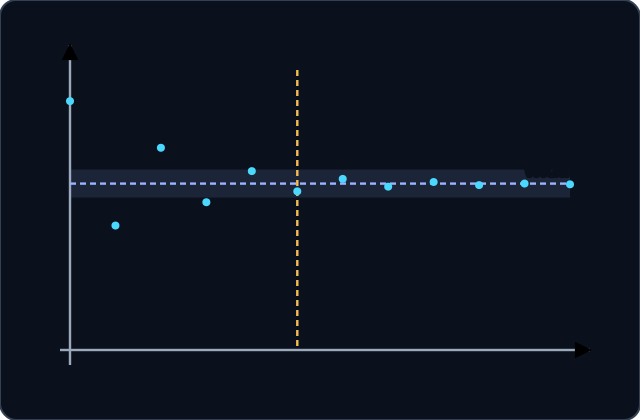
Past any two terms are within the given width of each other. The band is drawn round no particular number: the condition compares terms with terms, and never with a limit.
A condition with no limit in it
is Cauchy when for every there is an with for all . The Cauchy criterion states that a sequence of real numbers converges if and only if it is Cauchy. The easy direction is the triangle inequality with the limit in the middle; the hard direction is where completeness is spent, through Bolzano–Weierstrass.
What to watch
- Both indices run past independently. It is not enough that consecutive terms be close.
- does not imply Cauchy: the partial sums of have steps tending to zero and run away to infinity.
Every Cauchy sequence of reals converges
Three facts already proved do the work. A Cauchy sequence is bounded, so Bolzano–Weierstrass gives a subsequence converging to some number. That number is then shown to be the limit of the whole sequence: given a tolerance, go far enough out that any two terms are within half of it, and far enough along the subsequence that its terms are within half of the limit — then route from an arbitrary term through a subsequence term to the limit.
Proof steps
Apply the definition with tolerance one and take a maximum over the finite front.
Bolzano–Weierstrass applies to a bounded sequence.
Use the Cauchy condition at half the tolerance.
The subsequence eventually reaches past N and is eventually near L, so some index does both.
Route from an arbitrary later term through the subsequence term to the limit.
The tolerance was arbitrary, so the whole sequence converges to the same number.
Applications
Practice
Terms Against Terms
The condition compares two terms with each other. No limit appears in it, which is why it can be checked without knowing one.
Try it
What does it mean for a sequence to be Cauchy?
Try it
If then is Cauchy.
Try it
Why is a convergent sequence Cauchy?
Which Half Needs the Axiom
Convergent implies Cauchy needs only the triangle inequality. The converse is where completeness is spent.
Try it
Which direction of the Cauchy criterion uses completeness?
Try it
Every Cauchy sequence is bounded.
Try it
Why does the criterion fail in ?
Try it
For and , what is the least upper bound of the values , as a decimal?
Try it
In the hard direction, what is the role of the convergent subsequence?
What You Learned
- Cauchy compares terms with terms and names no limit.
- Consecutive terms shrinking is not enough.
- Convergent implies Cauchy by the triangle inequality; the converse spends completeness.
- The criterion fails in , where a Cauchy sequence can crowd around a missing point.
Final checkpoint
Try it
The Cauchy condition can be checked without knowing what the limit is.
Try it
Which sequence is Cauchy?
Completion
Lesson complete
Great work! You now know how to:
- State the Cauchy condition and say what is missing from it deliberately
- Give a sequence with shrinking steps that is not Cauchy
- Say which direction of the criterion spends completeness, and where
- Run the proof through boundedness, a subsequence and a routed triangle inequality