Intuition
Most of what is known about the forces between particles, from the nucleus Rutherford found to the quarks inside protons, was learned by scattering: fire a beam at a target and count what comes out in each direction. The count is summarised by the differential cross section : the number scattered per unit time into a small solid angle, divided by the incident flux, the number crossing unit area per unit time. It has the dimensions of an area — the area of beam the target turns into that direction — and over all directions it gives the total cross section . For classical particles it follows from the trajectories: a particle arriving with impact parameter leaves at an angle . In quantum mechanics there are no trajectories, and the problem becomes a stationary wave: a plane wave coming in, and an outgoing spherical wave carrying the scattered particles away.
Throw tennis balls blindfold at an unseen statue and note where they fly off: from enough throws you can piece together the statue’s shape. Scattering experiments read the shape of a potential the same way, from where the particles go.
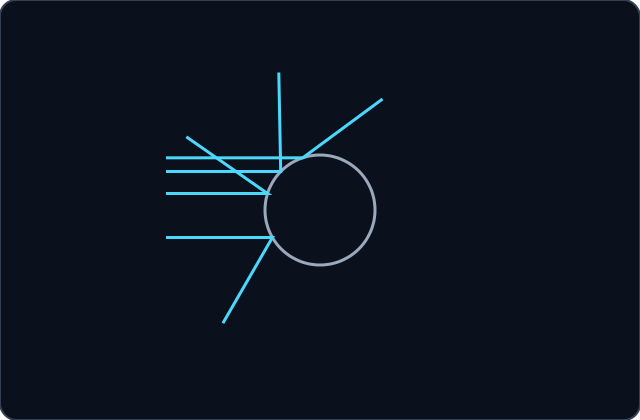
Classical particles bouncing off a hard sphere of radius , arriving from the left at different impact parameters : the nearer the axis, the further back they are thrown, with . Every particle with is scattered, so the classical cross section is the disc .
The scattering problem
A beam of flux , particles per unit area per unit time, falls on a target, and particles per unit time leave into the solid angle about the direction :
Properties
- is an area per unit solid angle; a common unit is the barn, m.
- Classically a particle with impact parameter leaves at the angle , and for a central force .
Classical scattering from a hard sphere
A particle reflects off the sphere like light off a mirror, so the angle of incidence fixes the scattering angle, and the impact parameter fixes the angle of incidence. The particles between and , all round the ring, land between and ; dividing the ring’s area by the solid angle gives a constant, whose integral is the sphere’s shadow.
Proof steps
Incidence at the angle to the normal, and mirror reflection.
Eliminate .
The ring of impact parameters and the ring of directions it lands in.
.
The same in every direction, over the full : exactly the area the sphere blocks.
Applications
Practice
Cross Sections
The cross section is the area of beam a target removes: for a classical hard sphere, every particle aimed within its radius.
Try it
Classically, what is the total cross section of a hard sphere of radius fm, in fm²? Give two decimal places.
The Differential Cross Section
The rate of particles scattered into a small solid angle, divided by the incident flux and by the solid angle.
Try it
What does the differential cross section measure?
An Area
A rate divided by a flux, particles per second over particles per second per square metre, is an area.
Try it
A cross section has the dimensions of an area.
Impact Parameter
For a hard sphere, a : a head-on particle bounces straight back, a grazing one passes almost undeflected.
Try it
A particle grazes the edge of a hard sphere, . At what angle does it leave?
Try it
A beam of flux ms meets nuclei, each with m²/sr. How many particles per second enter a detector of sr?
Try it
Classical particles scattered by a hard sphere come out equally in every direction.
Try it
At what impact parameter, in units of , is a classical particle scattered through by a hard sphere? Give three decimal places.
Final checkpoint
Try it
How is a steady beam described in the quantum scattering problem?
Try it
Quantum and classical hard spheres have the same total cross section at every energy.
Try it
Two particles scatter off each other. What does the problem reduce to?
Completion
Lesson complete
Great work! You now know how to:
- define the differential and total cross sections
- derive the classical cross section of a hard sphere
- set up the stationary quantum scattering problem