Intuition
To find , turn the Schrödinger equation into an integral equation with the boundary condition built in. Write it as with , and read the right-hand side as a source. A point source at the origin radiates the outgoing spherical wave , the Green’s function, and any source is a sum of point sources. So the solution is the incident wave plus the waves radiated by from every point where the potential acts: the Lippmann–Schwinger equation. Far away, all those waves travel in almost the same direction, and their sum is an outgoing spherical wave whose strength is an integral of with the phases — the scattering amplitude, in a formula exact for any short-range potential.
The sound heard far from a choir is the sum of every singer’s voice, each arriving with its own delay. The Green’s function is one singer’s voice; the integral equation adds them all, with the potential deciding how loudly each point sings.
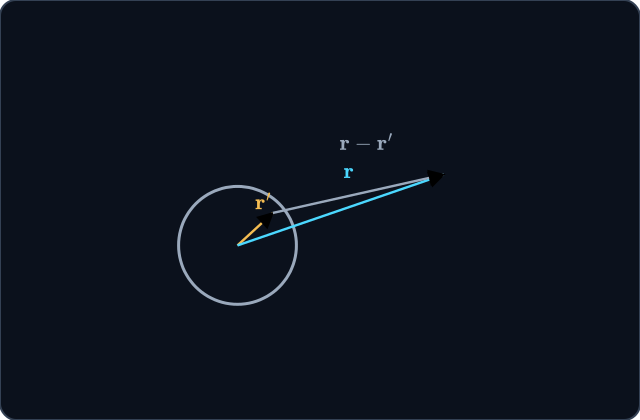
A potential confined to the dashed circle, a point inside it and a distant detector at . Far away, is less the projection of on the direction of , which turns each point’s wave into the same outgoing wave times the phase .
Green’s functions and the integral equation
With and , the scattering state solves
Properties
- solves and is an outgoing wave, ; the choice would describe waves converging on the target.
The scattering amplitude from the integral equation
The Green’s function turns the Schrödinger equation with its source into an integral equation. Far from the potential, the distance from a source point to the detector is less the source point’s projection on the direction of the detector; put that into , and the integral becomes an outgoing spherical wave times the amplitude.
Proof steps
The Schrödinger equation at the energy .
Away from the origin solves the free equation; near it is the potential of a point charge, whose Laplacian is the delta function.
The free wave plus the waves radiated by the source at every point.
For , with ; in the slowly varying , alone is enough.
Read off , and put back .
Applications
Practice
The Green’s Function
A point source radiates an outgoing spherical wave. It solves the free equation with a delta-function source.
Try it
Why is the Green’s function taken with rather than ?
An Exact Equation
The integral equation is the Schrödinger equation with the outgoing condition built in; only solving it needs approximations.
Try it
The integral equation is an approximation, valid only for weak potentials.
The Potential in Wavenumbers
Dividing the Schrödinger equation by turns the potential into , an inverse length squared like .
Try it
With MeV fm² and MeV inside a nucleus, what is , in fm?
Far Away
From far away, a point inside the potential is closer or farther by its projection on the direction to the detector.
Try it
For , what is to first order in ?
Try it
A detector is at m, and a point of the potential lies 2 m from the origin in the detector’s direction. What is in the far-field form, in metres?
Try it
Applying to the integral equation gives back the Schrödinger equation.
Try it
A potential acts in a region of volume fm³ so small that there, with fm and . From , what is , in fm? Give three decimal places.
Final checkpoint
Try it
Why can the exact formula for not be used directly?
Try it
The function would describe a wave converging on the target.
Try it
In the integral equation, what plays the part of the source of the scattered wave?
Completion
Lesson complete
Great work! You now know how to:
- turn the Schrödinger equation into an integral equation with a Green’s function
- derive the exact formula for the scattering amplitude
- explain why it has to be approximated