Intuition
Rutherford found his formula in 1911 from classical orbits, and quantum mechanics, remarkably, gives exactly the same cross section. The quickest way there is the Born approximation for the screened potential with , letting the screening length grow without limit: . The screening is not only a device. In real matter the atomic electrons screen the nucleus, and that removes the divergence of the bare formula at small angles. The pure Coulomb field is special twice over: it falls so slowly that the total cross section is infinite, and its waves never become free, carrying a phase that grows like the logarithm of the distance. Solved exactly, it still gives Rutherford’s formula (stated here) — a case where the Born approximation happens to be exact for the cross section.
A comet swinging past the Sun follows a hyperbola whose bend depends on how close it comes; comets arriving at random would spread out in exactly Rutherford’s pattern. Quantum mechanics, rather surprisingly, leaves that pattern unchanged.
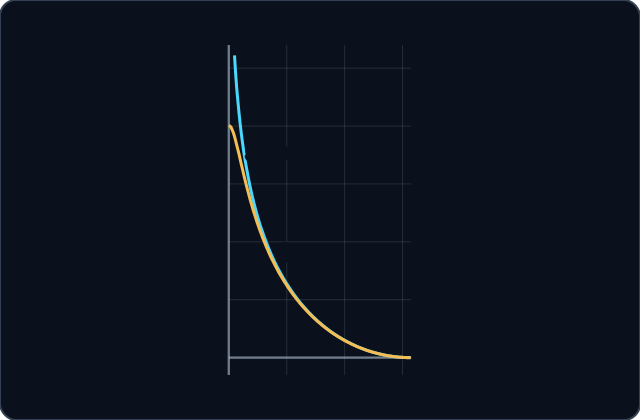
The Rutherford cross section against the scattering angle on a logarithmic scale — the base-10 logarithm of relative to its value straight back — for a bare Coulomb field, and for one screened at the distance . The bare one grows without limit as ; screening caps it.
Coulomb scattering
Two charges and , with , at the energy , scatter with the Rutherford cross section
Properties
- It is the same classically, in the Born approximation, and exactly (stated); it does not depend on the sign of .
- It grows without limit as , and the total cross section is infinite: the field reaches arbitrarily far.
- Screening by atomic electrons, , caps it: the forward cross section becomes finite, .
Rutherford’s formula from the screened potential
Take the Born amplitude of the screened potential and let the screening length grow without limit. What is left depends on the angle only through ; squaring and writing gives the formula, from which has cancelled.
Proof steps
The Born amplitude of from the last lesson.
.
No is left: the classical result.
Near the integrand behaves as .
Applications
Practice
Rutherford’s Formula
The Coulomb cross section falls as the fourth power of , and as the square of the energy.
Try it
By what factor is the Rutherford cross section at larger than at ?
Classical and Quantum Agree
Rutherford’s formula contains no : classical orbits, the Born approximation and the exact quantum solution all give it.
Try it
Quantum mechanics gives the same Coulomb cross section as classical mechanics.
Energy Dependence
The cross section goes as : faster particles are deflected less.
Try it
The energy of the beam is doubled. What happens to the Rutherford cross section at a fixed angle?
The Length \beta/4E
The combination is a length, a quarter of the closest approach in a head-on collision; it sets the size of the cross section.
Try it
Alpha particles, , of 5 MeV hit gold, . With MeV fm, what is , in fm? Give two decimal places.
Try it
Why is the total Coulomb cross section infinite?
Try it
Rutherford’s formula differs for attracting and repelling charges.
Try it
For the alpha particles of 5 MeV on gold, MeV fm. How close do they come in a head-on collision, in fm? Give one decimal place.
Final checkpoint
Try it
What does screening by atomic electrons do to the cross section?
Try it
Far from a Coulomb centre, the scattered wave is exactly an amplitude times .
Try it
Fast alpha particles scatter less than Rutherford’s formula predicts at large angles. What does that reveal?
Completion
Lesson complete
Great work! You now know how to:
- derive Rutherford’s formula as a limit of the screened potential
- explain why the Coulomb cross section is infinite
- say how screening and the nuclear force change it