Intuition
Far from a potential that falls off fast enough, a stationary scattering state looks like the incident plane wave plus an outgoing spherical wave whose strength depends on direction: . The function , with the dimensions of a length, is the scattering amplitude, and it holds everything a detector far away can learn. The makes the scattered intensity fall as , so the number of particles crossing a sphere round the target is the same whatever its radius, and computing the current through a small patch of that sphere gives the central formula of the subject: . For a central potential depends on alone.
Drop a stone into a pond crossed by steady waves: far away the old waves still pass, and a new circular ripple spreads out, stronger in some directions than in others. The scattering amplitude is that ripple’s strength, direction by direction.
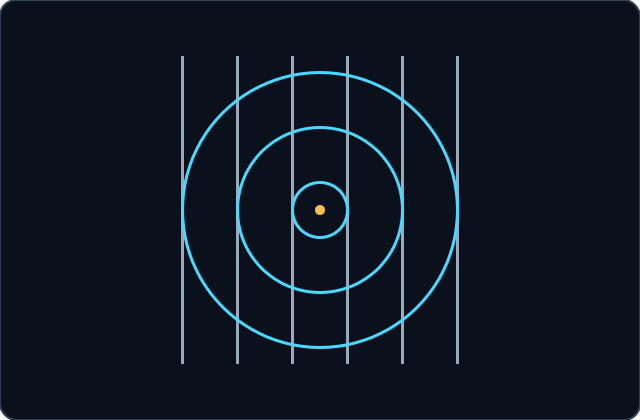
Crests of the incident plane wave, dashed, moving to the right, and of the outgoing spherical wave , solid, spreading from the target at the centre. Its intensity falls as , so the same number of particles crosses every sphere round the target.
The scattering amplitude
For a potential that falls faster than , the stationary state of energy far from the target is
Properties
- has the dimensions of a length; for a central potential it depends on alone.
- The incident current is along ; the scattered current is radial, , up to terms that fall faster.
The cross section is the squared amplitude
Compute the probability current of each part. The plane wave carries per unit area. The spherical wave’s current is radial and falls as , so through the patch it carries a fixed rate. Dividing the rate by the incident flux gives the cross section; the cross terms between the two waves oscillate with angle and matter only straight ahead.
Proof steps
The probability current of the dynamics chapter.
For , .
For ; the angular derivatives bring only terms falling as .
The rate through the patch of a sphere, the same at every radius.
Divide by the incident flux.
Applications
Practice
The Amplitude
Far away the scattering state is the plane wave plus , and the cross section in each direction is .
Try it
A scattering amplitude is fm in some direction. What is there, in fm² per steradian?
Why 1/r
The scattered intensity falls as while a sphere’s area grows as , so the same number of particles crosses every sphere.
Try it
Why does the outgoing wave carry the factor ?
A Length
The plane wave is a pure number and an inverse length, so the amplitude is a length.
Try it
The scattering amplitude has the dimensions of a length.
Try it
An amplitude is fm. What is , in fm² per steradian?
Central Potentials
A central potential looks the same from every side of the beam axis, so cannot depend on .
Try it
For a central potential, on what does depend?
Try it
The incident plane wave carries the current per unit area.
Try it
The scattered current is measured at m and then at m in the same direction. By what factor does it fall?
Final checkpoint
Try it
What does a counter far from the target measure?
Try it
The asymptotic form holds unchanged for the Coulomb potential.
Try it
What happens to in elastic scattering?
Completion
Lesson complete
Great work! You now know how to:
- write the asymptotic form of a scattering state
- derive from the probability current
- say what a detector can and cannot measure