Intuition
Each phase shift has a plain meaning: far from the potential, the radial wave of angular momentum is instead of , shifted by . An attractive potential pulls the wave in, a positive phase shift; a repulsive one pushes it out, a negative one. A hard sphere of radius pushes the s wave out by exactly : . Integrate over angles, and because the Legendre polynomials are orthogonal the partial waves do not interfere in the total: . Each term is at most , the unitarity limit, reached when . However strong the potential, one partial wave cannot scatter more.
A column of marchers crossing a patch of mud comes out a step behind, and one crossing a moving walkway a step ahead; which it is tells what they crossed. The phase shift is that step, lost or gained by the wave.
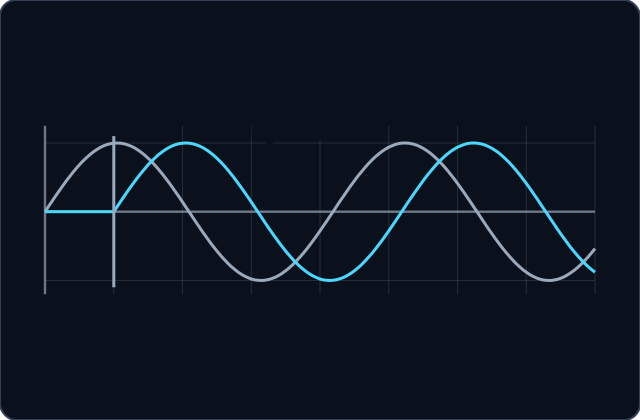
The -wave radial function of a free particle, , dashed, and outside a hard sphere of radius , , solid, with . The wall, the vertical line, pushes the whole wave out by : a phase shift .
Phase shifts
Far from the potential the radial function of partial wave is shifted by , and the cross section is a sum over partial waves:
Properties
- An attractive potential gives , pulling the wave in; a repulsive one gives .
The cross section from the phase shifts
Square the partial-wave sum and integrate over directions. The Legendre polynomials are orthogonal, so the cross terms between different partial waves vanish, and each contributes on its own. Its contribution is largest when .
Proof steps
does not depend on .
With ; the Legendre polynomials are real.
The Legendre polynomials are orthogonal.
Only survives, and .
.
Applications
Practice
The Unitarity Limit
One partial wave can scatter at most , reached when its phase shift is .
Try it
What is the largest possible -wave cross section at fm, in fm²? Give two decimal places.
Pulled In or Pushed Out
Inside an attractive potential the wave is shorter, so it comes out ahead: . A repulsive one leaves it behind: .
Try it
A potential gives a positive phase shift. What kind of potential is it?
No Cross Terms
The Legendre polynomials are orthogonal, so in the total cross section each partial wave counts on its own.
Try it
In the total cross section, different partial waves interfere with each other.
The Hard Sphere
Outside a hard sphere of radius the s wave is : it starts at the wall, shifted out by .
Try it
What is the -wave phase shift of a hard sphere of radius ?
Try it
Only the s wave scatters, with at fm. What is , in fm²? Give two decimal places.
Try it
Adding to a phase shift changes nothing observable.
Try it
A hard sphere of radius fm is hit with fm. What is , in radians?
Final checkpoint
Try it
How is a phase shift found for a given potential?
Try it
A strong enough potential can make one partial wave scatter more than .
Try it
At some energy while the other phase shifts are tiny. What is the cross section then?
Completion
Lesson complete
Great work! You now know how to:
- read a phase shift as a shift of the radial wave
- derive the total cross section from the phase shifts
- state and use the unitarity limit