Intuition
At low energy only the s wave scatters, and its phase shift vanishes in proportion to : . The length , the scattering length, then settles everything: and , the same at every angle and every low energy. For a hard sphere is its radius, so slow quantum particles see four times the classical cross section. For an attractive well can have either sign and any size. It grows without limit when the well is just deep enough to hold a new bound state at zero energy — a resonance at threshold — and it vanishes at special depths, where slow particles pass as if nothing were there. At higher energies a partial wave can resonate: climbs through within an energy range about , the cross section peaks at the unitarity limit with the Breit–Wigner shape, and the particle lingers in the potential for a time , a quasi-bound state.
A swing pushed in time with its own rhythm swings high and keeps swinging after the pushes stop; pushed out of time it barely moves. A resonance is the potential’s rhythm: particles at just the right energy are held a while before they leave.
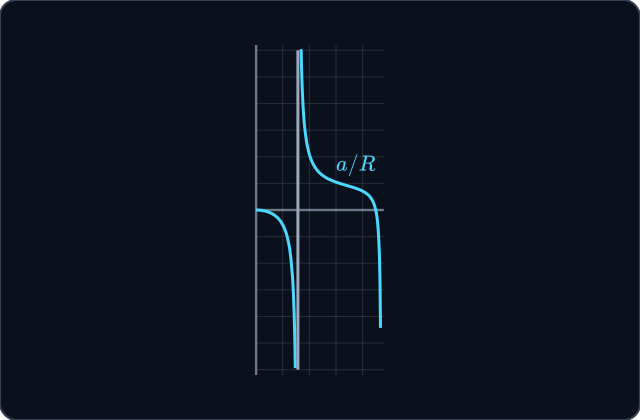
The scattering length of a square well of radius , in units of , against its strength . It diverges at , dashed, where a bound state appears at zero energy, and it vanishes at , where slow particles pass through the well unscattered.
Low-energy scattering and resonances
As the -wave phase shift defines the scattering length ; near a resonance of partial wave at the energy , of width :
Properties
- In general as : the higher partial waves die out fast at low energy.
The scattering length of a square well
Solve for the s wave inside and outside and match the logarithmic derivative at the edge. At low energy the outside wave is a straight line, , whose zero is the scattering length; the inside wave is a sine with the well’s wavenumber. Matching fixes .
Proof steps
Inside the well, with vanishing at the centre.
With , .
The logarithmic derivative is continuous at .
Solve for .
A new bound state at zero energy, and a well that slow particles do not see.
Applications
Practice
The Scattering Length
At low energy tends to , a length called the scattering length, and the cross section to , the same in every direction.
Try it
A neutron and a proton, in the state in which they bind into the deuteron, have the scattering length fm. What is their low-energy cross section in that state, in fm²? Give the nearest whole number.
Only the s Wave
As , vanishes as : the centrifugal barrier keeps slow particles with away from the potential.
Try it
Why does only matter at low energy?
Four Times the Shadow
A hard sphere of radius has scattering length , so slow quantum particles see , four times the classical cross section.
Try it
Slow quantum particles see a hard sphere with the classical cross section .
Resonance at Threshold
The scattering length of a well diverges when the well is just deep enough to hold a new bound state at zero energy.
Try it
When does the scattering length of a well become very large?
Try it
A square well has . What is ? Give three decimal places.
Try it
A narrower resonance lives longer.
Try it
A resonance has the width eV. With eV s, what is its lifetime, in units of s?
Final checkpoint
Try it
At the centre of a resonance, , what is the partial cross section?
Try it
A well can be invisible to slow particles.
Try it
At low energy . For a hard sphere of radius , what is ?
Completion
Lesson complete
Great work! You now know how to:
- define the scattering length and the low-energy cross section
- derive the scattering length of a square well
- describe a resonance by its energy and width