Intuition
If the potential is weak, the wave inside it is nearly the incident plane wave, and the exact formula for can be evaluated with replaced by . That is the Born approximation, first order in the potential: the amplitude is the Fourier transform of the potential at the momentum transfer , where and . It turns scattering into Fourier analysis. A potential of range scatters strongly only for , so fast particles are thrown mostly forward, and the width of the forward peak reads off the size of the target. For the screened potential the amplitude is . The approximation holds when the potential barely changes the wave inside it: , or for fast particles.
A pane of slightly uneven glass blurs a distant light, and the blur pattern is a Fourier picture of the unevenness. A weak potential scatters a wave the same way, the amplitude in each direction measuring one Fourier component of the potential.
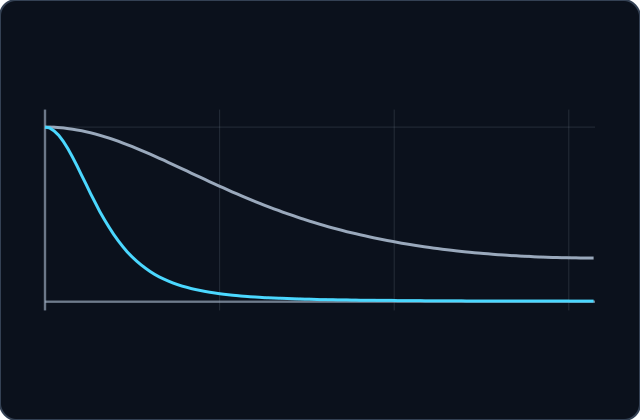
The Born cross section of the screened potential against the scattering angle, relative to its forward value, for and . The faster particles are scattered into a narrow forward peak; the slower ones spread over every angle.
The Born approximation
Replacing by inside the potential, with :
Properties
- For a central potential , a function of alone.
The Born amplitude of a screened potential
Put the plane wave into the exact formula: the amplitude becomes the Fourier transform of at . For a central potential the angular part of the integral gives , leaving one radial integral, which for the screened potential is elementary. Elastic scattering fixes from and .
Proof steps
The exact formula with .
Two vectors of length at the angle .
Take as the polar axis and integrate over directions.
The imaginary part of .
Collect the factors of .
Applications
Practice
Momentum Transfer
In elastic scattering through , the wave vector changes by , of length .
Try it
A particle with fm scatters through . What is , in fm?
A Fourier Transform
In the Born approximation the amplitude is the Fourier transform of the potential at the momentum transfer, times .
Try it
In the Born approximation, what is the scattering amplitude?
Weak Potentials
The Born approximation keeps the potential to first order: the incident wave stands in for the true wave inside it.
Try it
The Born approximation is first order in the potential.
Forward for Fast Particles
A potential of range has Fourier components only up to of about , so faster particles scatter into narrower forward cones.
Try it
A potential of range is probed with faster and faster particles. What happens to the angular pattern in the Born approximation?
Try it
For with fm and fm, what is the forward Born amplitude , in fm?
Try it
The Born approximation holds for any potential if the particles are slow enough.
Try it
A nucleon, MeV, meets a potential of strength 1 MeV and range 1 fm. With MeV fm, what is ? Give three decimal places.
Final checkpoint
Try it
For at , what is ?
Try it
For slow particles, , the Born cross section of a short-range potential is nearly the same in every direction.
Try it
What does the next term of the Born series describe?
Completion
Lesson complete
Great work! You now know how to:
- derive the Born amplitude from the integral equation
- compute it for the screened potential
- judge when the approximation holds