Intuition
For a central potential the angular momentum is conserved, so it pays to split the beam into its angular-momentum parts. The plane wave is a sum over of spherical waves , and far away each of them is an incoming and an outgoing spherical wave of equal strength. The potential cannot turn one into another, and it cannot change the number of particles in each: all it can do is change the phase of the outgoing part, by the factor . The amplitude becomes a sum over partial waves, . What makes it practical is a classical picture: a particle with angular momentum passes the centre at the impact parameter , so a potential of range affects only . Slow particles need a single partial wave, .
Sort a crowd walking past a lamppost by how far from it each person walks. Those passing beyond the lamppost’s reach are not affected at all; only the few passing close are. Partial waves sort a beam by impact parameter, and the potential touches only the nearest.
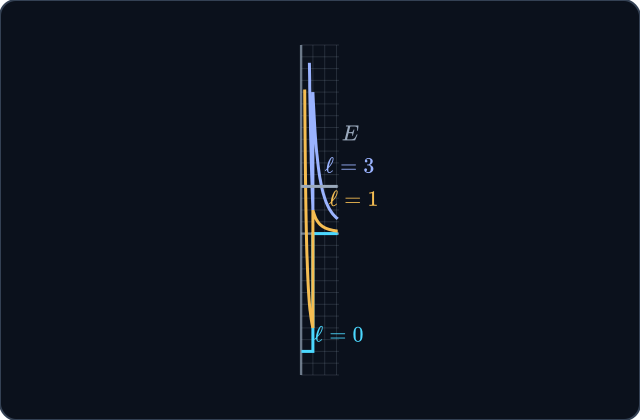
The effective potential of a square well of radius , for , 1 and 3, in units where and , with the energy dashed, so . The centrifugal barrier of rises above outside the well, so that partial wave barely feels it: only scatter.
Partial waves
For a central potential of range and , each angular momentum scatters on its own, with a phase shift :
Properties
- , the spherical Bessel functions behaving as far away (stated).
The partial-wave amplitude
Project the plane wave onto one Legendre polynomial and integrate by parts: far away only the ends of the interval survive, which gives the incoming and outgoing spherical waves of each partial wave. The potential can change only the phase of the outgoing part. The scattered wave is what differs from the plane wave, and its coefficient is the amplitude.
Proof steps
Integrate by parts; each further integration brings another .
, , and fixes the weights.
The incoming waves are the same; the potential multiplies each outgoing one by , with .
Only outgoing waves are left: this is .
.
Applications
Practice
Which \ell Count
A particle with angular momentum passes the centre at , so a potential of range affects only up to about .
Try it
A potential of range fm is probed with fm. Up to about which do partial waves scatter?
One \ell at a Time
A central potential conserves angular momentum, so it cannot turn one partial wave into another.
Try it
Why does a central potential scatter each partial wave separately?
Only a Phase
In elastic scattering the outgoing part of each partial wave keeps its strength; only its phase changes, by .
Try it
In elastic scattering, the potential can change only the phase of each outgoing partial wave: .
Straight Ahead
Every Legendre polynomial is 1 in the forward direction, so there all the partial waves simply add.
Try it
What is in the forward direction, ?
Try it
With fm only the s wave scatters, with . What is , in fm? Give one decimal place.
Try it
Partial waves with much larger than scatter as strongly as the s wave.
Try it
A particle with fm has . At about what impact parameter does it pass the centre, in fm?
Final checkpoint
Try it
What is in terms of ?
Try it
When only the s wave scatters, the differential cross section does not depend on the angle.
Try it
What keeps high partial waves away from a short-range potential?
Completion
Lesson complete
Great work! You now know how to:
- expand a scattering state in partial waves
- derive the amplitude from the phase shifts
- explain why only up to about matter