Intuition
Particles scattered out of the beam must be missing from it: behind the target there is a shadow. The shadow is made by interference between the scattered wave and the incident one straight ahead, and so it depends on the forward amplitude. Counting shows that the total cross section is fixed by the imaginary part of the forward amplitude alone: , the optical theorem. In partial waves it holds wave by wave, for , which puts every elastic amplitude on one circle in the complex plane. It holds too when the target absorbs particles, for the total of scattered and absorbed. A black disc of radius , absorbing every partial wave up to , absorbs and scatters as much again, into a narrow forward peak that fills in its shadow: .
A pillar in a stream leaves a wake behind it, and the water missing from the wake is exactly the water turned aside. Measure the wake straight downstream and you know how much the pillar deflects in all directions.
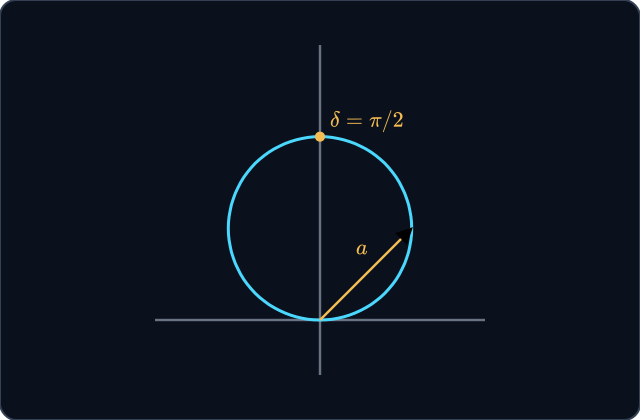
The complex plane of a partial-wave amplitude , real part across and imaginary part up. As runs from 0 to , goes once round the circle of radius about , on which : the optical theorem wave by wave. The arrow is ; the top, , is the unitarity limit. Absorption pulls inside the circle.
The optical theorem
The total cross section, of scattering and of absorption together, is fixed by the forward amplitude:
Properties
- Partial wave by partial wave, for : every elastic amplitude lies on the circle of radius about .
The optical theorem from the partial waves
In the forward direction every Legendre polynomial is 1, so the forward amplitude is the plain sum of the partial amplitudes. Its imaginary part collects from each, which is exactly what the cross section collects. With absorption the same comparison goes through for the total, with in place of .
Proof steps
.
.
The cross section from the phase shifts, compared term by term.
Elastic and absorbed add: ; and .
Applications
Practice
The Theorem
The total cross section is times the imaginary part of the forward amplitude.
Try it
A total cross section is fm² at fm. What is , in fm? Give two decimal places.
The Shadow
Particles scattered away are missing from the forward beam; that loss comes from the interference of the scattered and incident waves straight ahead.
Try it
Where does the optical theorem come from physically?
With Absorption
When the target absorbs, , and the theorem gives the total of the scattered and the absorbed.
Try it
The optical theorem still holds when the target absorbs some particles, for the total cross section.
The Unitarity Circle
Every elastic partial-wave amplitude lies on the circle of radius about , where its imaginary part equals its squared modulus.
Try it
On which curve in the complex plane does an elastic lie?
Try it
What is the total cross section of a black disc of radius 1 fm at high energy, in fm²? Give two decimal places.
Try it
For a real central potential, the Born approximation satisfies the optical theorem.
Try it
What is the radius of the circle on which every elastic lies?
Final checkpoint
Try it
A black disc absorbs . Why is its total cross section ?
Try it
The optical theorem gives the total cross section from the amplitude in the forward direction alone.
Try it
At which point of the unitarity circle is the partial cross section largest?
Completion
Lesson complete
Great work! You now know how to:
- derive the optical theorem from the partial waves
- extend it to targets that absorb
- explain the shadow of a black disc