Intuition
Draw a solution not against time but as a moving point, with its two unknowns as coordinates. As time runs the point traces a curve, a trajectory, and time survives only as the direction of travel, marked with an arrow. Through each point passes exactly one trajectory, so trajectories never cross, and a family of them, the phase portrait, shows every solution of the system in one picture. An equilibrium is a trajectory that is a single point, and the question this chapter keeps asking is what the other trajectories do near it.
A ship’s track on a chart. It shows where the ship went and which way, but not when it passed each point; for that you need the log book, which is the graph against time.
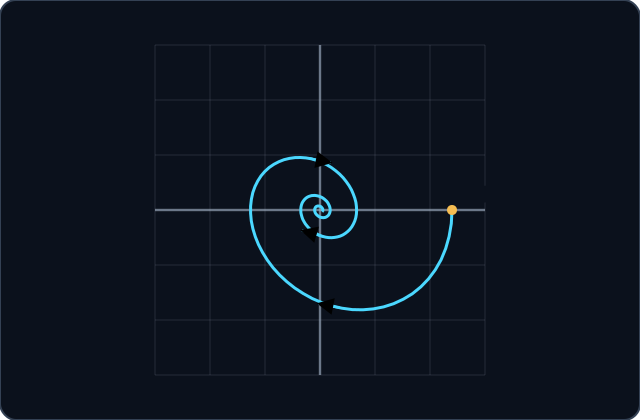
The damped spring , , started at at rest, with position across and velocity up. The trajectory turns clockwise and spirals in to the origin, where the spring comes to rest.
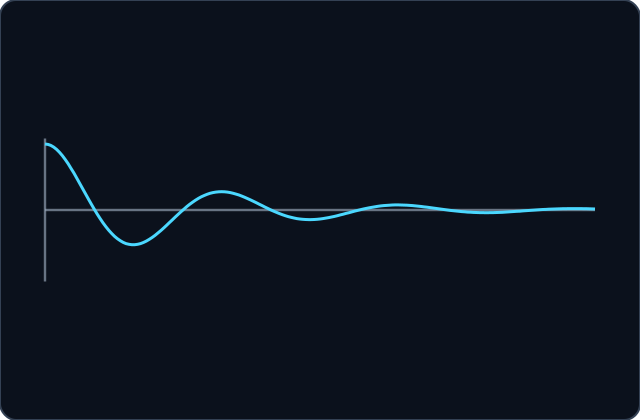
The same motion with time across: the position swings and dies away. The trajectory above holds all of this except the time at which each point is reached.
Trajectories and the phase portrait
A trajectory of is the curve traced by a solution, with an arrow for the direction of increasing , and a phase portrait draws enough of them to show them all. An equilibrium is stable if solutions starting near it stay near it, asymptotically stable if they also approach it, and unstable if some start arbitrarily near it and still leave. On a line an isolated equilibrium that keeps nearby solutions near also draws them in, which is why chapter two needed only one word; in the plane they can circle it for ever instead.
Reading a portrait
- At each point the trajectory runs in the direction of the velocity , at the speed given by its length.
- Trajectories never cross, and none reaches an equilibrium in finite time: it can only approach one as .
- A closed trajectory is a periodic solution: the point returns to where it was and repeats the same motion.
- For the point moves right wherever and left wherever , so a spring's trajectories cross the horizontal axis vertically and turn clockwise.
Trajectories never cross
A system whose rates do not depend on time is unchanged by a delay, so a solution started later is still a solution. If two trajectories share a point, reached at different times, delay one of them so that both reach the point at the same moment. Uniqueness then makes them the same solution, so the two trajectories are one curve traced at different times.
Proof steps
The rates do not depend on time, so a delayed solution is still a solution.
Choose the delay so that both reach the shared point at the same time.
Two solutions with the same value at the same time are the same solution.
So the second trajectory is the first traced at a delay: one curve, not two crossing.
Applications
Practice
Which Way the Point Moves
At each point the velocity is given by the right-hand sides. The sign of x′ says left or right, and the sign of v′ says down or up.
Try it
For , , which way does the point move as it passes ?
Try it
Two different trajectories of can cross at a point.
Try it
What kind of solution does a closed trajectory, a loop, correspond to?
Try it
For , , what is at the point ?
Try it
A trajectory that is not an equilibrium can reach an equilibrium at a finite time.
Try it
How do the trajectories of , cross the horizontal axis, where ?
Try it
, solves , , and so does , . At what time does the second first reach ?
Try it
The trajectories of a mass on a spring, drawn with position across and velocity up, turn which way?
Final checkpoint
Try it
A trajectory drawn in the phase plane shows how fast the point moves along it.
Try it
How many equilibria does , have?
Try it
Solutions starting near an equilibrium stay near it, but go round it for ever without approaching it. What is the equilibrium?
Completion
Lesson complete
Great work! You now know how to:
- draw a solution as a trajectory in the phase plane
- read the direction of motion from the velocity
- prove that trajectories never cross
- tell stable, asymptotically stable and unstable apart