Intuition
Many quantities change together: salt flowing between two tanks, predators and their prey, the position and the velocity of a moving mass. A system of differential equations gives the rate of each quantity in terms of all of them, and a solution is a pair of functions that satisfies every equation at once. Nothing earlier is lost: naming the velocity turns any second-order equation into a system of two first-order ones, so everything so far is a special case of what this chapter studies.
Two rooms joined by an open door. Heat flows from the warmer room to the cooler one, so how fast each room warms depends on both temperatures. Neither room can be understood on its own.
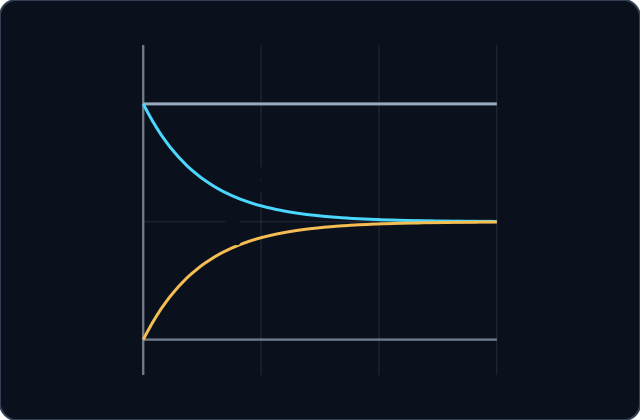
Two tanks exchanging salt, and , the first starting with units and the second with none. Each rate depends on both amounts; the total stays , and both amounts approach .
Two unknowns, two equations
A system of two first-order equations gives the rates of two unknown functions and in terms of both: and . A solution is a pair of differentiable functions satisfying both equations at every of an interval, and an initial value problem fixes and . The system is linear with constant coefficients when both rates are fixed combinations of and , as below, and that is the kind this chapter solves. A point where both rates vanish is an equilibrium: the constant pair sitting there is a solution.
What a system is
- The equations are coupled when each rate depends on the other unknown; neither can then be solved on its own.
- A second-order equation is the system , , where is the velocity.
A second-order equation is a first-order system
Name the velocity. If x solves the second-order equation, the pair of x and its derivative satisfies both equations of the system: the first is the definition of the velocity and the second is the equation itself. Conversely, if a pair solves the system, the first equation says the second function is the derivative of the first, and substituting it into the second equation gives back the second-order equation.
Proof steps
Name the velocity as a new unknown.
If x solves the equation, the pair of x and v solves the system.
If the pair solves the system, the first equation turns the second back into the equation.
So the two problems have the same solutions, with the same starting data: a position and a velocity.
Applications
Practice
From One Equation to a System
Name the velocity v. Its definition is one equation of the system, and the original equation, rewritten with v, is the other.
Try it
Which system is , with ?
Try it
In the system , , the equation for can be solved on its own.
Try it
For which is , a solution of , ?
Try it
What is a solution of a system of two first-order equations?
Try it
For the tanks , , the total is the same at every time.
Try it
The tanks , start with and . What amount does approach?
Try it
How many numbers must an initial value problem for a system of two first-order equations give at the starting time?
Try it
At what value of is the equilibrium of , ?
Final checkpoint
Try it
Written as a first-order system, has how many unknown functions?
Try it
Two different solutions of , can have the same values at the same time.
Try it
Which system is linear?
Completion
Lesson complete
Great work! You now know how to:
- say what a system and its solutions are
- turn a second-order equation into a first-order system and back
- find the equilibria of a system
- spot a quantity a system conserves