Intuition
On the border between nodes and spirals sits the case of one repeated eigenvalue. If the matrix has only one eigenvector direction, it gives only one straight-line solution, and the second needs a factor of time, just as a repeated root needed a factor of x in chapter four. The trajectories then all come in tangent to that single direction, turning part of the way round as they do: a degenerate node. If instead every vector is an eigenvector, the matrix is a multiple of the identity and every solution is a straight ray: a star.
A crowd leaving a stadium through a single gate. People come from every side, but all of them walk the last stretch in the one direction the gate allows.
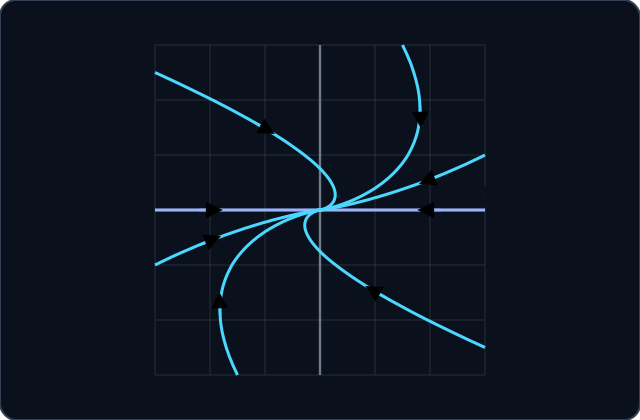
, : the repeated eigenvalue has the single eigenvector direction . Every trajectory arrives tangent to the horizontal axis; those from above swing round to come in from the right, and those from below from the left.
One repeated eigenvalue
If the eigenvalues are equal, . If , every vector is an eigenvector and every solution is : a star. Otherwise there is one eigenvector direction , and a second solution uses a vector with ; every solution is the combination below. For the origin is a stable degenerate node and every trajectory arrives tangent to ; for it is unstable.
The border case
- : , and , since .

Every matrix is a point here, its trace across and its determinant up. Below the axis are the saddles; above the parabola , where the eigenvalues repeat, the spirals; between the two, the nodes; and on the upper half of the vertical axis, the centres. The left half is stable and the right half unstable.
The second solution for a repeated eigenvalue
Differentiate by the product rule: the exponential brings down lambda, and the factor t brings down one more copy of v. Apply the matrix instead, using that it sends v to lambda times v and w to lambda times w plus v. Both sides come out as the same three terms, so the function is a solution; its value at time zero, w, is independent of v, so with the straight-line solution it forms a fundamental pair.
Proof steps
Differentiate by the product rule.
Apply the matrix; the exponential and t are numbers.
Use the two equations for v and w.
The two sides are the same three terms.
Applications
Practice
One Eigenvalue, One Direction
A repeated eigenvalue with only one eigenvector direction gives one straight-line solution. The second needs a factor of t, as a repeated root did in chapter four.
Try it
Which matrix has a repeated eigenvalue with only one eigenvector direction?
Try it
What is the repeated eigenvalue of ?
Try it
For , every solution of moves along a straight line.
Try it
For , with eigenvector , which is a second solution?
Try it
For and , the vector solves . What is ?
Try it
The spring , written as a system, has a repeated eigenvalue.
Try it
How do the trajectories of , approach the origin?
Try it
For , with and , what is at ? Give two decimal places.
Final checkpoint
Try it
and . Which describes the eigenvalues?
Try it
For a repeated eigenvalue with eigenvector , the function is a second solution.
Try it
A matrix has the eigenvalue repeated. What is ?
Completion
Lesson complete
Great work! You now know how to:
- find the second solution for a repeated eigenvalue
- prove that it solves the system
- tell a degenerate node from a star
- place every kind of equilibrium in the trace–determinant plane