Intuition
When the two eigenvalues have opposite signs, one straight line carries solutions out and the other carries them in. Every other solution does some of each: it comes in close to the incoming line, swings past the origin and leaves along the outgoing one, like a ball rolled over a mountain pass. The origin is then a saddle, and it is unstable: only the solutions that start exactly on the incoming line ever reach it.
A mountain pass. Along the ridge the pass is the lowest point, so a ball set on the ridge path rolls down to it; across the ridge the pass is the highest point, so a ball set anywhere else rolls away into one of the valleys.
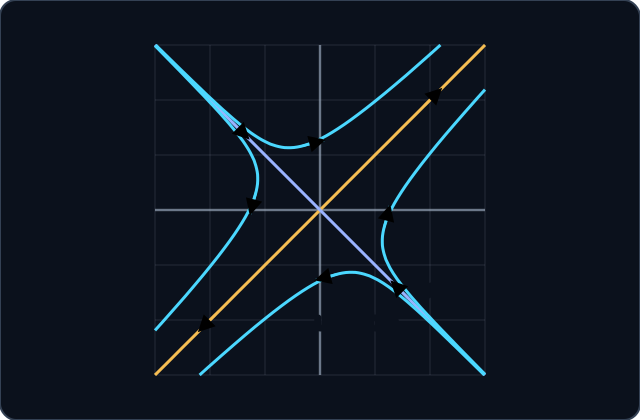
The saddle of , with eigenvalues and . Solutions come in along the stable line , turn near the origin and leave along the unstable line ; only those on the stable line itself arrive.
Eigenvalues of opposite signs
If the eigenvalues are real with , and the origin is a saddle. The solutions on the stable line approach the origin; those on the unstable line, , leave it; and every other solution, with and , arrives from the direction of and leaves in the direction of . A saddle is always unstable.
What a saddle does
- is negative only for real eigenvalues of opposite signs: a complex pair has product .
A negative determinant makes a saddle
The product of the eigenvalues is the determinant. A complex pair multiplies to a sum of squares, which cannot be negative, so the eigenvalues are real, and two real numbers with a negative product have opposite signs. With one eigenvalue of each sign, one term of every solution grows and the other decays, so every solution with a part along the unstable line leaves.
Proof steps
The eigenvalues multiply to the determinant.
A complex pair cannot have a negative product, so the eigenvalues are real.
Two real numbers with a negative product have opposite signs.
The growing term takes over, so every solution with a part along the unstable line leaves.
Applications
Practice
The Determinant Decides
The eigenvalues multiply to the determinant, so a negative determinant means real eigenvalues of opposite signs: a saddle.
Try it
Which matrix gives a saddle?
Try it
What is for ?
Try it
A saddle is a stable equilibrium.
Try it
Which solutions of a saddle approach the origin as time goes on?
Try it
The eigenvalues of are and . Which is the eigenvalue of the stable line?
Try it
If , the eigenvalues of are real.
Try it
with and . What happens as ?
Try it
starts at . What is ?
Final checkpoint
Try it
For , with on and on , which start leads to the origin?
Try it
A trajectory of a saddle can cross one of its two straight lines.
Try it
A saddle has eigenvalues and . What is ?
Completion
Lesson complete
Great work! You now know how to:
- recognise a saddle from a negative determinant
- prove that its eigenvalues are real and of opposite signs
- say which solutions arrive and which leave
- fit a solution and tell whether it reaches the origin