Intuition
When both eigenvalues are real and have the same sign, every solution moves the same way: in, if both are negative, or out, if both are positive. The origin is a node. The two parts of a solution fade at different rates, so the faster one disappears first, and every trajectory comes in along the direction of the slower eigenvector, tangent to the slow line. Reversing time turns a stable node into an unstable one: the same picture, with the arrows the other way.
Rain on a wide, shallow valley with a stream along its floor. Water from anywhere runs quickly down to the stream and then flows slowly along it to the lake. The stream is the slow eigenvector.
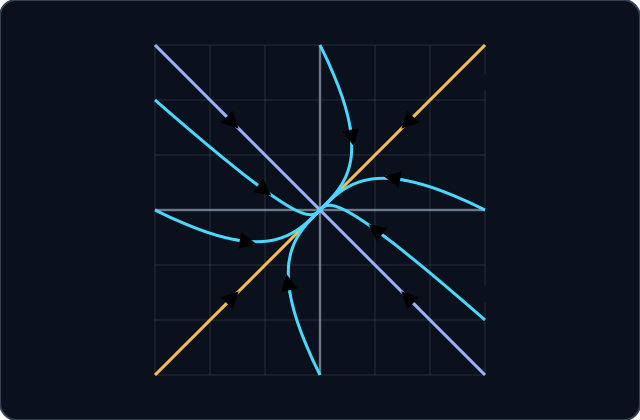
The stable node of , with eigenvalues on and on . The fast part along dies first, so every trajectory off the fast line comes in tangent to the slow line .
Two real eigenvalues of one sign
If the eigenvalues are real, different and both negative, , the origin is a stable node: every solution approaches it, and every one off the fast line arrives tangent to the slow eigenvector . If both are positive the origin is an unstable node, with the same trajectories traced outwards. In terms of the matrix, makes the signs agree, makes the eigenvalues real and different, and the sign of is the sign of both.
What a node does
- : , and , so a stable node, with eigenvalues and .
Trajectories enter a stable node tangent to the slow eigenvector
Both parts of a solution die, but at different rates. Divide the solution by the slower exponential: the slow part becomes constant and the fast one still decays, because the difference of the two rates is negative. So the rescaled solution approaches a multiple of the slow eigenvector, which means the direction of the solution approaches that eigenvector while the solution itself shrinks to zero.
Proof steps
The general solution for two different real eigenvalues.
Divide by the slower exponential.
The fast part still decays after the rescaling.
So the direction of the solution approaches that of the slow eigenvector, while the solution itself shrinks to zero.
Applications
Practice
Same Signs, No Turning
Two real eigenvalues of the same sign: both negative is a stable node, both positive an unstable one.
Try it
Which matrix gives a stable node?
Try it
A stable node has eigenvalues and . Trajectories come in tangent to the eigenvector of which eigenvalue?
Try it
Running an unstable node backwards in time gives a stable node.
Try it
, written as a system, has what kind of equilibrium at the origin?
Try it
For , what is ?
Try it
In a node every trajectory is a straight line.
Try it
A node has eigenvalues on and on . How do trajectories off the straight lines approach the origin?
Try it
starts at . What is ?
Final checkpoint
Try it
and . What is the origin?
Try it
At a stable node every solution approaches the origin.
Try it
An unstable node has eigenvalues and . What is ?
Completion
Lesson complete
Great work! You now know how to:
- recognise a stable or unstable node
- prove that trajectories arrive tangent to the slow eigenvector
- classify from the trace and the determinant
- connect the overdamped spring to its phase portrait