Intuition
Stack the two unknowns into one vector and the two equations into one: the system becomes the derivative of the vector equal to a matrix applied to it. Read that way, the matrix assigns a velocity to every point of the plane, and a solution is a path that at every moment moves with the velocity the matrix gives at the point it has reached. Linear algebra then does the work: solutions add because matrices are linear, and there are exactly two independent ones because the plane has dimension two.
A weather map of the wind. At every place an arrow says which way the air moves and how fast, and a balloon released anywhere drifts along the arrows. The matrix is the map, and a solution is the balloon.
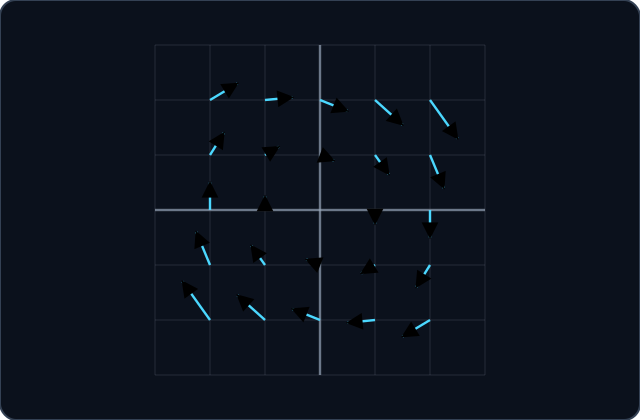
The velocities of , at points of the plane, each drawn a quarter of its length. A solution moves along these arrows at their speed: here it turns clockwise and drifts in towards the origin.
A matrix times a vector
With written as a column, the system , is : the first row of holds the coefficients of the equation for , and the second those for . Because is linear, every combination of solutions is a solution. Two solutions whose starting vectors are independent form a fundamental pair, and every solution is a combination of them.
Reading the matrix
- , has .
The solutions form a space of dimension two
Combinations of solutions are solutions, because the matrix is linear, so the solutions form a vector space. Send each solution to its value at time zero. That map is linear; it is one-to-one, because the only solution starting at the origin is the zero solution; and it is onto, because a solution starts from every vector. A linear map that is one-to-one and onto the plane preserves dimension, so the solution space has dimension two.
Proof steps
The derivative and the matrix are both linear, so combinations of solutions are solutions.
Send each solution to its starting vector; the map is linear.
The zero function is a solution starting at the origin, and by uniqueness the only one.
By existence, a solution starts from every vector of the plane.
A linear bijection onto the plane preserves dimension.
Applications
Practice
Rows Are Equations
The first row of A holds the coefficients of the equation for x′, and the second row those for y′. The first column multiplies x and the second multiplies y.
Try it
The system , is with below. Select the entry that multiplies in the equation for .
Try it
Which matrix writes , as ?
Try it
For , what is the second component of the velocity at the point ?
Try it
If and solve , then so does .
Try it
For which matrix does have a whole line of equilibria?
Try it
What is the dimension of the space of solutions of when is a matrix?
Try it
Writing with gives below. Select the entries that come from the equation itself rather than from the definition .
Try it
For written as a system, .
Final checkpoint
Try it
Two solutions of start at and . Do they form a fundamental pair?
Try it
What is the trace of for , ?
Try it
Select the entries of that couple the two equations of .
Completion
Lesson complete
Great work! You now know how to:
- write a system as a matrix acting on a vector
- read the velocity a matrix gives at a point
- prove that the solutions form a space of dimension two
- find the equilibria from the determinant