Intuition
When the eigenvalues are a complex pair there is no real eigenvector, so no solution moves in a straight line: every solution turns about the origin. The imaginary part of the eigenvalues sets how fast it turns, and the real part whether it winds in, towards the origin, or out, away from it. The origin is a spiral, stable when the real part is negative. The underdamped spring of chapter five is exactly this: its trajectories spiral in as the oscillation dies.
Water going down a plughole. It circles and moves inwards at the same time, and the two motions together draw a spiral. Run the flow backwards and the same spiral winds outwards.
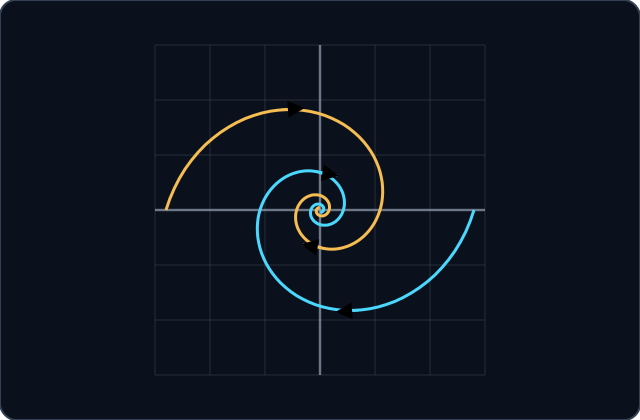
, , with eigenvalues . Two solutions started on opposite sides turn clockwise once every , while their distance from the origin shrinks by the factor .
Complex eigenvalues
If the eigenvalues are a complex pair with and . The real and imaginary parts of the complex solution , for a complex eigenvector , are two real solutions, as in chapter four, and each is times a motion that turns once every . So the origin is a stable spiral when , an unstable spiral when , and a centre, the next lesson, when .
Reading a spiral
- : , so .
The real part decides
Take the matrix with the complex pair written into it, which every matrix with complex eigenvalues becomes in suitable coordinates. Differentiate the squared distance from the origin: the terms with beta, which only turn the point, cancel in pairs, and what is left is twice alpha times the squared distance. So the squared distance changes exponentially at the rate twice alpha, and the distance itself at the rate alpha: in when alpha is negative, out when it is positive.
Proof steps
Differentiate the squared distance from the origin.
Put in the two equations.
The turning terms cancel in pairs.
An exponential equation for the squared distance: the distance is multiplied by e to the alpha t.
Applications
Practice
Complex Eigenvalues Turn
A complex pair of eigenvalues makes every solution turn. The real part says whether it winds in or out.
Try it
Which matrix gives an unstable spiral?
Try it
What is the real part of the eigenvalues of ?
Try it
A spiral has solutions that move along straight lines through the origin.
Try it
Which way do the trajectories of , turn?
Try it
For , , a solution starts at distance from the origin. What is its distance at ?
Try it
The spring with , written as a system, has a stable spiral at the origin.
Try it
For which trace and determinant are the eigenvalues complex?
Try it
How long do the solutions of , take to turn once around the origin? Give two decimal places.
Final checkpoint
Try it
The eigenvalues are . What is the origin?
Try it
For a matrix with complex eigenvalues, the spiral winds in exactly when the trace is negative.
Try it
The eigenvalues of are with . What is ?
Completion
Lesson complete
Great work! You now know how to:
- recognise a spiral from complex eigenvalues
- prove that the real part decides whether it winds in or out
- find the direction and the time of one turn
- connect the underdamped spring to its phase portrait