Intuition
Look for the simplest possible motion: a solution that moves along a straight line through the origin, only stretching or shrinking as time goes on. Such a solution is a fixed vector times an exponential, and substituting it into the system gives a condition on the vector: the matrix must send it to a multiple of itself. That is exactly an eigenvector, and the multiple is its eigenvalue. Two independent eigenvectors give two straight-line solutions, and every solution is a combination of them.
Wind blowing along a straight valley. A leaf dropped on the valley floor is carried along the valley and never leaves it. The eigenvectors are the valleys of the matrix: directions in which it only pushes forwards or back.
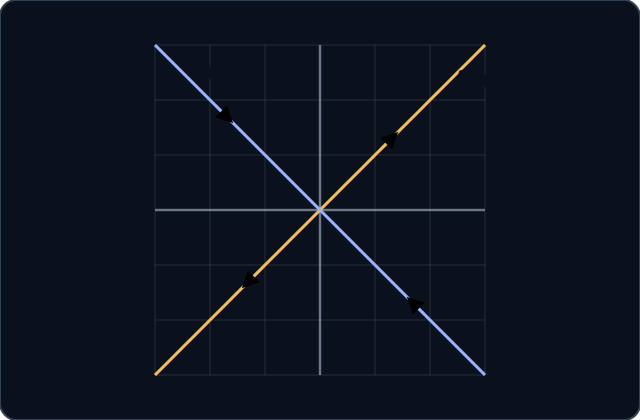
with . Along the eigenvector the solution moves straight out; along the solution moves straight in.
Straight-line solutions
If with , then solves : a solution moving along the line through , outwards when and inwards when . The eigenvalues are the roots of . When they are real and different, the two eigenvectors are independent and every solution is the combination below, with its constants fixed by the starting vector.
Working with it
- : gives and , with eigenvectors and .
An eigenvector gives a straight-line solution
Differentiate the trial solution: the exponential brings down its rate, and the vector is constant. Apply the matrix instead: the exponential is a number and comes out, and the matrix acts on the vector. The two agree at every time exactly when the matrix sends the vector to the rate times itself — when the vector is an eigenvector and the rate its eigenvalue.
Proof steps
A fixed vector, stretched or shrunk exponentially.
The vector is constant, so only the exponential is differentiated.
The exponential is a number and comes out of the matrix product.
Dividing by the exponential, which is never zero, leaves the eigenvector equation.
Applications
Practice
Eigenvectors Move in Straight Lines
If A sends v to λ times itself, then the exponential of λt times v solves the system: a point moving along the line through v.
Try it
Which is a solution of with ?
Try it
What is the larger eigenvalue of ?
Try it
If , the solution moves along a straight line towards the origin.
Try it
Which vector is an eigenvector of for ?
Try it
starts at . What is ?
Try it
If is an eigenvalue of , then has a line of equilibria.
Try it
The eigenvalues of a matrix are the roots of which polynomial?
Try it
The eigenvalues of multiply to what?
Final checkpoint
Try it
has eigenvalues and , with eigenvectors and . What is the general solution of ?
Try it
Eigenvectors for two different eigenvalues are linearly independent.
Try it
For , what is the second component of ?
Completion
Lesson complete
Great work! You now know how to:
- find straight-line solutions from eigenvectors
- prove that an eigenvector gives a solution
- write the general solution for two real eigenvalues
- fit the constants to a starting vector