Intuition
When the eigenvalues are purely imaginary there is turning but no winding: every solution goes round a closed loop for ever, and the origin is a centre. The frictionless spring is the model: its energy is conserved, and the loops are the curves of constant energy. A centre is stable, since nearby solutions stay near, but not asymptotically stable, since they never arrive. It is also fragile: the smallest friction turns it into a stable spiral, and the smallest push into an unstable one.
A marble rolling round the inside of a perfectly smooth bowl at a fixed height. Nothing pulls it down and nothing lifts it, so it goes round the same path for ever; a breath of friction and it slowly spirals to the bottom.
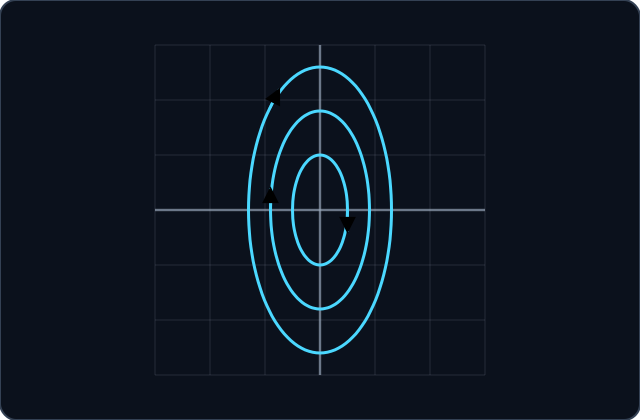
The centre of , , with eigenvalues . Every solution goes clockwise round an ellipse and returns after the time , whatever its size.
Purely imaginary eigenvalues
If and , the eigenvalues are with , and the origin is a centre. Every solution is periodic with period , and its trajectory is an ellipse about the origin. A centre is stable, because each solution stays on its own ellipse, and not asymptotically stable, because none approaches the origin.
What a centre does
- The frictionless spring is , , with eigenvalues .
The energy is conserved, and every trajectory closes
Differentiate the quantity along a solution and substitute the two equations: the two terms are equal and opposite, so it never changes, and each solution stays on one ellipse. The only point where the velocity vanishes is the origin, so a solution on an ellipse keeps moving round it in one direction, returns to its start, and from there, by uniqueness, repeats.
Proof steps
Twice the energy of the spring, in these units.
Differentiate along a solution.
Substitute the equations: the terms cancel.
Each solution stays on one ellipse, and goes round it for ever.
Applications
Practice
Zero Trace, Positive Determinant
When the trace is zero and the determinant positive, the eigenvalues are purely imaginary and every solution goes round a closed loop.
Try it
Which matrix gives a centre?
Try it
What is the period of the solutions of , ? Give two decimal places.
Try it
At a centre, solutions approach the origin as time goes on.
Try it
A centre's matrix has its trace changed from to . What becomes of the origin?
Try it
For , , the solution starting at next crosses the vertical axis at . What is ?
Try it
A centre is stable: solutions that start near the origin stay near it.
Try it
and . What is the origin?
Try it
What is for the centre of ?
Final checkpoint
Try it
Which equation, written as a system, has a centre at the origin?
Try it
Every trajectory of a centre, except the origin itself, is a closed loop.
Try it
For , , a solution passes through . How far from the origin is it at every time?
Completion
Lesson complete
Great work! You now know how to:
- recognise a centre from zero trace and positive determinant
- prove that the energy is conserved and the trajectories close
- find the period of the loops
- explain why a centre is stable but fragile