Intuition
Around 1900 physics looked nearly finished: Newton for matter, Maxwell for light. Then a few plain experiments refused to fit. Light knocked electrons out of metals in lumps rather than in a stream, atoms that ought to have collapsed in a flash sat stable and glowed only in certain colours, and single electrons fired at two slits built up the stripes of a wave.
Classical physics is a ramp, on which any height is allowed. The experiments kept finding a staircase: energy handed over in steps, light arriving in packets, atoms that can only stand on certain stairs. Quantum mechanics began as the theory of the staircase and turned out to be the theory of everything small.
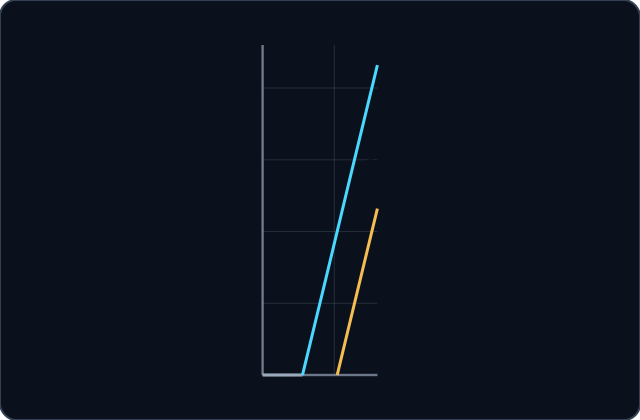
The largest energy of an electron knocked out of a metal, in eV, against the frequency of the light in Hz. Below a threshold nothing comes out however bright the light; above it the energy climbs a straight line whose slope is Planck's constant , the same for every metal.
Three facts classical physics cannot hold
Light of frequency exchanges energy with matter only in whole quanta of , where J s is Planck's constant. Matter, in turn, behaves as a wave whose wavelength is set by its momentum. Quantum mechanics is the theory that makes both statements consistent, and the rest of this course builds it.
What the experiments showed
- The photoelectric effect: an electron leaves a metal with energy at most , where is the work needed to free it. Brighter light frees more electrons, never faster ones. Einstein's reading, in 1905, was that light arrives in packets, later called photons.
- Atomic stability: a classical electron circling a nucleus is an accelerating charge, which radiates and spirals inward in about s. Real atoms last for ever.
- Line spectra: a gas of hydrogen emits only sharp wavelengths, the visible ones at 656, 486, 434 and 410 nm. Each is the energy difference between two allowed levels of the atom.
Applications
Practice
Light Arrives in Packets
Light of frequency is absorbed and emitted only in whole packets of energy, each worth . One packet frees at most one electron.
Try it
What does the photoelectric effect show when the light is made brighter at a fixed frequency?
The Photon Energy in Electronvolts
For light it is easier to know the wavelength than the frequency. Planck’s relation then reads , and with the product written in convenient units it is one division.
Try it
Using eV nm, what is the energy in eV of a photon of red light of wavelength 620 nm?
Energy Left Over
The photon hands all its energy to one electron. Part of it pays the work function , the cost of leaving the metal, and the rest is the most kinetic energy the electron can leave with.
Try it
Photons of energy 4.0 eV fall on sodium, whose work function is 2.3 eV. What is the largest kinetic energy, in eV, of an electron that leaves the metal?
What Brightness Does
A brighter beam of the same colour carries more photons per second, each with the same energy. The number of electrons follows the brightness; their energy does not.
Try it
Doubling the intensity of the light, at a fixed frequency above the threshold, doubles the largest kinetic energy of the electrons it frees.
Why Atoms Should Not Exist
Classically an electron circling a nucleus is always changing direction, so it is accelerating, and an accelerating charge radiates. Losing energy, it spirals inward.
Try it
Why is a classical atom, with an electron orbiting a nucleus, unstable?
Try it
Hydrogen gas emits light only at a few sharp wavelengths. What does that say about the atom?
Matter Has a Wavelength
de Broglie’s relation gives every particle a wavelength fixed by its momentum. For an electron accelerated through a voltage , the kinetic energy is , so the momentum grows as .
Try it
An electron accelerated through 150 V has a de Broglie wavelength of about 0.1 nm. Through how many volts must it be accelerated for its wavelength to be half as long?
Final checkpoint
Try it
When electrons are sent through two slits so slowly that only one is in the apparatus at a time, no interference pattern forms.
Try it
How many times more energy does a photon of wavelength 400 nm carry than a photon of wavelength 800 nm?
Try it
Planck and Einstein proposed that light of frequency exchanges energy with matter only in certain amounts. Which amounts?
Completion
Lesson complete
Great work! You now know how to:
- say which experiments broke classical physics, and why
- compute a photon energy from a wavelength with eV nm
- use for the fastest photoelectron
- scale a de Broglie wavelength with momentum