Intuition
Once a basis is chosen, a state is nothing but its list of coefficients, one amplitude per basis state. The coefficient of a basis state is the bracket of that state with the one being described, the modulus squared of each coefficient is a probability, and the probabilities add to one because the state is normalised. Inner products and norms can then be computed from the lists alone.
A recipe lists how much of each ingredient goes in. Choose a different set of ingredients and the same dish needs a different list, but it is the same dish. The coefficients are the recipe of a state in one basis.
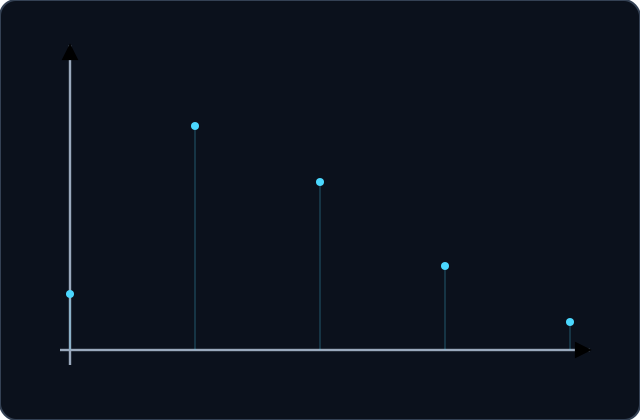
The moduli squared of one normalised state in a basis of five states. They are the probabilities of the five outcomes, and they add to one: .
Coefficients in a basis
In an orthonormal basis a state is with . Its norm and its inner products with other states are computed from the coefficients alone, and for a normalised state the numbers are the probabilities of finding it in each basis state.
Computing with coefficients
- The inner product of with is , in any orthonormal basis.
Parseval’s identity
Insert the completeness relation between the bra and the ket of . Each term of the resulting sum is a bracket times its own conjugate, a modulus squared. The length of a vector is fully accounted for by its components along any orthonormal basis.
Proof steps
Nothing changes when the identity is put between the bra and the ket.
Write the identity as , the completeness relation.
Swapping the sides of a bracket conjugates it.
Each term is a coefficient times its conjugate, its modulus squared.
Applications
Practice
Coefficients Are Amplitudes
In a basis, a state is its list of coefficients. For a normalised state, the modulus squared of each coefficient is the probability of the corresponding basis state.
Try it
. What is the probability of finding it in ?
The Same State, Another Basis
To find the probability of an outcome in another basis, compute the bracket with that basis bra and square its modulus. The coefficients in the old basis are what the bracket is computed from.
Try it
and . What is ?
Lengths From Coefficients
Parseval’s identity: the squared length of a vector is the sum of the moduli squared of its coefficients in any orthonormal basis.
Try it
A state has coefficients and in an orthonormal basis. What is ?
Inner Products From Coefficients
In an orthonormal basis the inner product is the sum of the conjugated coefficients of the bra times the coefficients of the ket.
Try it
and . What is ? Give three decimal places.
Try it
A normalised state has coefficients and in an orthonormal basis of four states. What is ?
Try it
A state has the same list of coefficients in every orthonormal basis.
Try it
In an orthonormal basis , which expression gives the coefficient of ?
Final checkpoint
Try it
in an orthonormal basis. What is the probability of or , taken together?
Try it
Changing a single coefficient to , and no other, leaves every probability in that basis unchanged.
Try it
For a normalised state, what do the numbers over an orthonormal basis form?
Completion
Lesson complete
Great work! You now know how to:
- find the coefficients of a state as brackets with basis states
- compute norms and inner products from coefficients
- read probabilities off coefficients, and see them change with the basis