Intuition
Light can be polarised horizontally or vertically. It can also be polarised diagonally, and a diagonal wave is exactly a horizontal and a vertical one added in step. For single photons this addition becomes a principle: if a system can be in one state and can be in another, it can be in any combination of the two, and that combination is a new state with definite properties of its own.
North-east is not a coin that is sometimes north and sometimes east. It is a direction of its own, built from north and east. A diagonally polarised photon is the same: sent at a diagonal polariser it passes every time, which no mixture of horizontal and vertical photons would ever do.
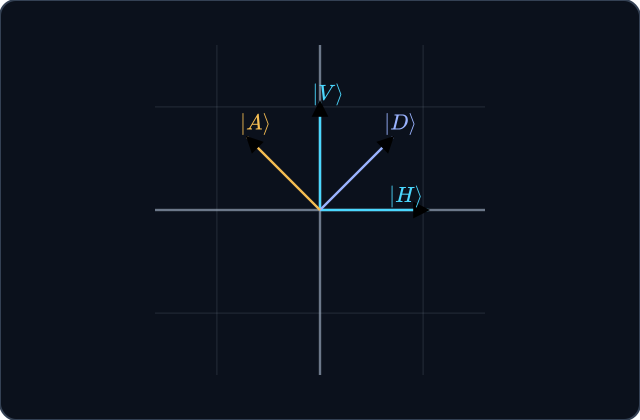
The four polarisation states used throughout this chapter. Diagonal is and antidiagonal is : the same two ingredients in the same amounts, differing only in a relative sign.
The superposition principle
A state of a quantum system is written as a ket, , a symbol for a vector. If and are possible states, so is every combination with complex coefficients. The coefficients are amplitudes: for two perfectly distinguishable states and the probabilities of finding the system in each are and .
What a state is and is not
- The condition says the probabilities add to one; a state satisfying it is normalised.
- A global phase changes nothing: and are the same physical state, because every probability involves a modulus squared.
Applications
Practice
States Add
A superposition is a sum of states with complex coefficients. It is itself a state, as definite as the ones it is built from.
Try it
Which of these is a normalised superposition of and that contains both?
Probabilities From Coefficients
For a state written in the horizontal and vertical pair, the probability that a horizontal polariser passes the photon is the modulus squared of the coefficient of .
Try it
A photon in the state meets a horizontal polariser. What is the probability that it passes?
A Common Phase Is Invisible
Multiplying a whole state by a phase changes every amplitude by the same factor of modulus one, so no probability changes. Physically it is the same state.
Try it
The states and describe the same physical situation.
A Relative Phase Is Physical
Changing the sign of one coefficient, and not the other, is a relative phase. It leaves the probabilities for horizontal and vertical alone but changes the state.
- passes a diagonal polariser with certainty.
Try it
How can the states and be told apart?
Try it
A state is with and both real and positive. What is the probability that it passes a horizontal polariser?
Try it
A photon polarised at 60 degrees to a polariser’s axis arrives at the polariser. What is the probability that it passes?
Try it
A beam of photons each in the state behaves in every experiment like a beam in which half the photons are horizontal and half are vertical.
Final checkpoint
Try it
What is a qubit?
Try it
A photon is polarised at 30 degrees above the horizontal. What is the probability that it passes a vertical polariser?
Try it
The states and give the same probabilities at a horizontal polariser.
Completion
Lesson complete
Great work! You now know how to:
- write a superposition as a ket with complex coefficients
- normalise a state and read probabilities from its coefficients
- tell a global phase, which changes nothing, from a relative one, which changes the state
- distinguish a superposition from a mixture