Intuition
The bracket of two states measures how much they overlap. A state has overlap one with itself when it is normalised, and overlap zero with a state it can be told apart from with certainty. In between, the overlap is an amplitude: its modulus squared is the probability that a system prepared in one state passes a test for the other. The Cauchy–Schwarz inequality is the guarantee that this never exceeds one.
For arrows, the dot product measures how much one points along another. The complex inner product is the same idea with conjugation built in, so that the length of an arrow always comes out real and positive.
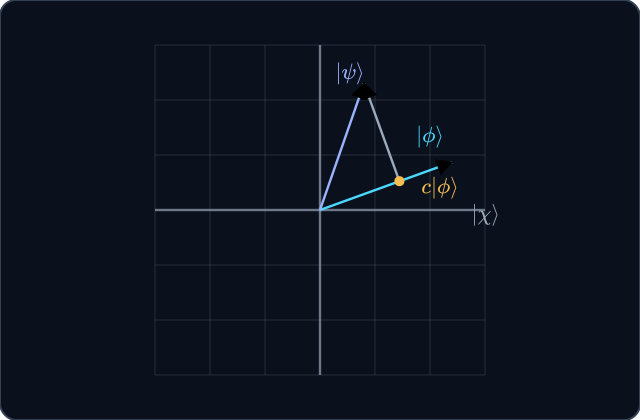
The proof of the Cauchy–Schwarz inequality in a picture. The dot is the part of along ; what is left, , is at right angles to . Since has a length of at least zero, the part along can be no longer than itself.
Overlap, length and orthogonality
The inner product of two vectors is their bracket . It is linear in the ket, conjugate-linear in the bra, conjugate-symmetric, and positive on every nonzero vector. The norm, or length, of a vector is ; a state is normalised when its norm is 1.
Consequences
- Two vectors are orthogonal when . Orthogonal states are the ones a single measurement can tell apart with certainty.
- Normalising: has norm 1 and describes the same state.
- For normalised states, is the probability that a system in is found to be in . It is 1 when the states are the same up to phase and 0 when they are orthogonal.
The Cauchy–Schwarz inequality
Split into a part along and a remainder orthogonal to it. Pythagoras makes the squared length of the sum of the two parts' squared lengths, and dropping the remainder, which is at least zero, gives the inequality. Equality holds exactly when there is no remainder, that is when is a multiple of .
Proof steps
For , subtract from its component along . (If both sides are zero.)
The remainder is orthogonal to : that is what the choice of was for.
Since with the two parts orthogonal, the cross terms vanish.
Drop and substitute .
Multiply through by the positive number . Equality needs , that is a multiple of .
Applications
Practice
The Norm
The length of a vector is the square root of its inner product with itself, the sum of the moduli squared of its components.
Try it
What is the norm of the vector with components ?
Conjugate First
The inner product conjugates the components of the left-hand vector. Leaving the conjugation out gives a wrong answer that can look very reasonable.
Try it
What is the inner product of with , the first vector on the left?
Normalising
Divide a vector by its norm to get a normalised vector describing the same state.
Try it
By what number must the vector be multiplied to normalise it? Give it to three decimal places.
Overlap as Probability
For normalised states, the modulus squared of the inner product is the probability that a system prepared in one is found in the other.
Try it
With and , what is ?
Try it
Two vectors have norms 2 and 3. What is the largest possible value of ?
Try it
If for nonzero vectors, then is a multiple of .
Try it
What does it mean physically for two normalised states to be orthogonal?
Final checkpoint
Try it
If , then .
Try it
What is for and ?
Try it
Which is , the inner product with the bra of , for a complex number ?
Completion
Lesson complete
Great work! You now know how to:
- compute norms and normalise vectors
- test orthogonality without forgetting the conjugate
- read the modulus squared of an overlap as a probability
- prove the Cauchy–Schwarz inequality and say when it is an equality