Intuition
States can be added and multiplied by complex numbers, so they are vectors. The space they live in is called a Hilbert space: a vector space over the complex numbers with a way to measure how much two vectors overlap. For a qubit it is just pairs of complex numbers. For a particle on a line it is a space of functions, one complex number for every point: a vector with infinitely many components.
A list of twelve numbers is a vector with twelve components. Write down a function’s value at a thousand points, then a million: the list gets longer but it is still a vector. A wavefunction is what that list becomes when the points fill the line.
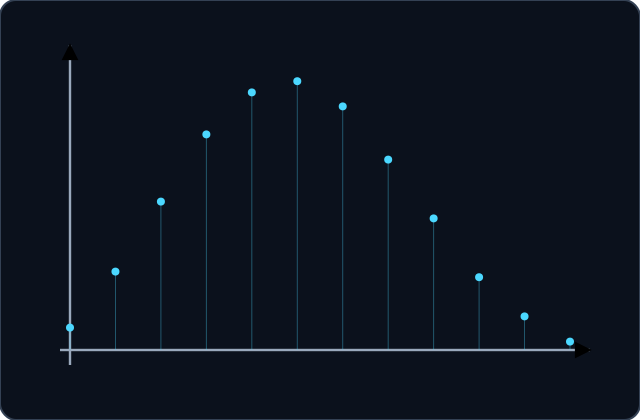
A function sampled at twelve points is a vector with twelve components, each the value at one point. With more points the list becomes the function itself, and the space of such functions is a Hilbert space with infinitely many dimensions.
The space quantum states live in
A Hilbert space is a vector space over with an inner product — a rule giving a complex number for any two vectors, the next lessons' subject — in which every sequence of vectors that settles down converges to a vector of the space. The Linear Algebra course met vector spaces over the real numbers; here the scalars are complex, because amplitudes are.
The two kinds met in this course
- : columns of complex numbers, added entry by entry. A qubit lives in ; a system with three perfectly distinguishable outcomes lives in .
Applications
Practice
Complex, Not Real
A qubit needs two complex numbers, one amplitude for each of its two distinguishable states. Its space is the set of pairs of complex numbers.
Try it
Which vector space do the states of a qubit belong to?
Dimension Counts Distinguishable Outcomes
The dimension of the state space is the largest number of states that one measurement can tell apart with certainty. A qubit has two; a system with three such states needs three complex numbers.
Try it
A system has exactly three states that one measurement can tell apart with certainty. What is the dimension of its state space?
States Versus Vectors
The Hilbert space contains every vector, normalised or not. A physical state is represented by a normalised vector, and the normalised vectors alone are not closed under addition.
Try it
The sum of two normalised vectors is always normalised.
Square-Integrable Functions
For a function to be a normalisable state of a particle on a line, the integral of its modulus squared over the whole line must be finite.
Try it
Which of these functions of is square-integrable over the whole real line?
Try it
How many real numbers does it take to write down a general vector of ?
Try it
The sum of two square-integrable functions on the line is again square-integrable.
Try it
Why are the scalars of a quantum state space complex numbers rather than real ones?
Final checkpoint
Try it
Two qubits together have four joint states that can be told apart with certainty: 00, 01, 10 and 11. What is the dimension of their joint state space?
Try it
Functions of can be vectors: adding two of them and multiplying one by a number obey the same rules as adding and scaling arrows.
Try it
What is the dimension of the state space of a particle that can be anywhere on a line?
Completion
Lesson complete
Great work! You now know how to:
- say what a Hilbert space is and why its scalars are complex
- give the dimension of a state space from its distinguishable outcomes
- tell a square-integrable function from one that is not