Intuition
Quantum mechanics is the first physical theory that cannot be written without complex numbers. An amplitude has a size and a direction, like an arrow in a plane. Adding amplitudes means adding arrows, which can cancel each other completely, and multiplying by a phase turns the arrow without changing its length.
Think of a complex number as a clock hand. Its length is how much of something there is; the hour it points to is its phase. Two hands pointing the same way add up to a long hand, two pointing opposite ways cancel. Most of quantum mechanics is careful bookkeeping of those hands.
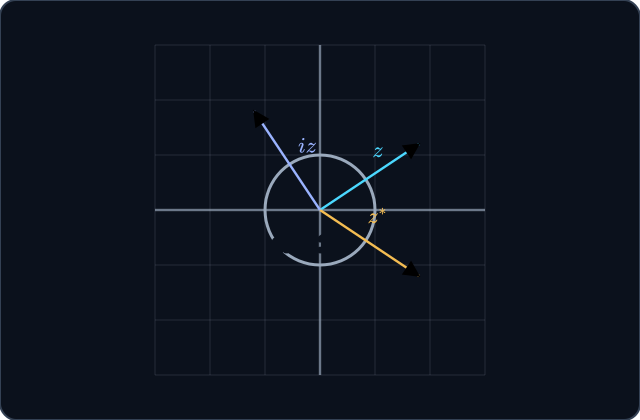
A complex number drawn as the arrow to . Its conjugate is its mirror image in the real axis, and is the same arrow turned a quarter turn anticlockwise. Every number on the grey circle has modulus 1.
Size and phase
A complex number has a real part and an imaginary part , with . Drawn as an arrow, its length is the modulus and its angle from the real axis is the phase . Euler's formula writes the same number in polar form.
Rules used everywhere in this course
- The conjugate flips the sign of : . The conjugate of a sum or a product is the sum or product of the conjugates.
The interference formula
Write the modulus squared as the number times its conjugate, multiply out, and notice that the two cross terms are conjugates of each other, so together they are twice a real part. With the cross term is : the whole of interference is in that cosine.
Proof steps
A modulus squared is a number multiplied by its own conjugate.
Multiply out, using that the conjugate of a sum is the sum of the conjugates.
The two cross terms are conjugates of each other, because conjugating a product conjugates each factor.
A number plus its conjugate is twice its real part, so the cross terms add up to .
In polar form , whose real part is the cosine of the difference of phases.
Applications
Practice
The Length of the Arrow
The modulus of a complex number is the length of its arrow, found by Pythagoras from the real and imaginary parts. Its square is the number times its conjugate.
Try it
What is ?
The Conjugate
Conjugating changes the sign of everywhere and nothing else. On the arrow picture it reflects the number in the real axis.
Try it
What is the complex conjugate of ?
A Number Times Its Conjugate
Multiplying a complex number by its conjugate always gives a real, non-negative number: the modulus squared. The imaginary parts cancel.
Try it
What is ?
Multiplying Turns the Arrow
Multiplying by a number of modulus one changes only the direction of an arrow. Multiplying by adds a quarter turn to the phase.
Try it
What does multiplying a complex number by do to its arrow?
Try it
What is the modulus ?
Try it
For any two complex numbers, .
Try it
What is ?
Try it
What is the real part of ?
Final checkpoint
Try it
What is ?
Try it
What is ?
Try it
Multiplying two complex numbers and by the same phase leaves unchanged.
Completion
Lesson complete
Great work! You now know how to:
- find a modulus, a conjugate and a product of complex numbers
- read multiplication by a phase as a rotation
- expand the modulus squared of a sum into two squares and an interference term