Intuition
Send electrons one at a time through two slits and count where they land. With one slit open you get one smooth hump; with the other, another. With both open you do not get the sum of the two humps: you get stripes, with places no electron ever reaches even though each slit alone sent electrons there. Quantum mechanics explains this with one rule: each way something can happen has a complex amplitude, and when the ways cannot be told apart the amplitudes are added before squaring.
Probabilities are like heights of sand piles: two piles always make a bigger pile. Amplitudes are like water waves: two crests make a bigger crest, but a crest meeting a trough leaves flat water. Nature adds the waves first and only then asks how much is there.
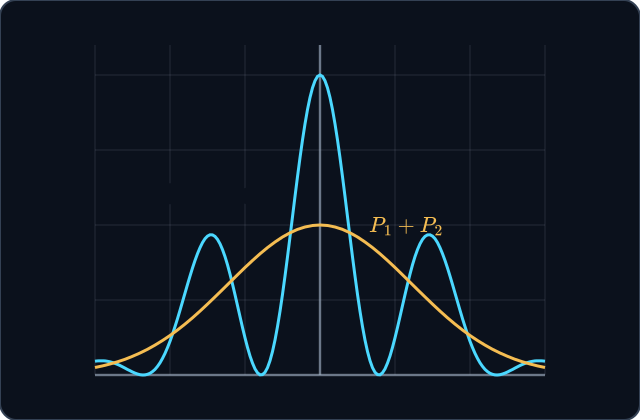
Where the electrons land, across the screen. The dashed curve is what adding the two one-slit probabilities predicts. The measured pattern swings between four times one slit's contribution and zero: , not .
Adding amplitudes, then squaring
To every way an event can happen, quantum mechanics assigns a complex number, its amplitude, and the probability of the event is the modulus squared of the total amplitude. When an event can happen in two ways that nothing in the universe distinguishes, the total amplitude is the sum of the two.
The rules of amplitudes
- A probability is the modulus squared of an amplitude: . Amplitudes can be negative or complex; probabilities cannot.
- Indistinguishable alternatives add amplitudes. The last term above, the interference term, is what makes dark fringes: at a point where the probability is zero.
Applications
Practice
Add, Then Square
When an event can happen in two ways that are not distinguished, add the two complex amplitudes and take the modulus squared of the sum.
Try it
An electron can reach a point on the screen through slit 1, with amplitude , or through slit 2, with amplitude , and nothing records which. What is the probability of arriving there?
Two Equal Amplitudes in Step
When two amplitudes are equal, the total is twice either one, and the probability is four times either alone: twice what adding probabilities would give.
Try it
At a point on the screen each slit alone gives amplitude , and the two amplitudes are equal. What is the probability of arriving there with both slits open?
A Dark Fringe
Where the two amplitudes are equal in size and opposite in sign, they cancel, and the probability is zero — even though each slit alone would send electrons there.
Try it
At a point the amplitude through slit 1 is and through slit 2 is . What is the probability of arriving there with both slits open?
Opening a Route Can Close a Point
Adding a second path adds an amplitude, and an amplitude can point against the first. More ways of getting somewhere can mean less chance of getting there.
Try it
If each slit alone sends an electron to some point with probability 0.1, then with both slits open the probability of arriving there is at least 0.1.
Knowing the Path
If anything records which slit the electron used — a detector, a photon scattered off it, a change in the slit — the two alternatives are distinguishable, and their probabilities add.
Try it
A detector is placed at the slits that records which one each electron passes through. What happens to the pattern on the screen?
Try it
Through one slit the amplitude to reach a point has modulus and through the other , with a phase difference that can be anything. What is the largest probability of arriving there with both open?
Try it
At a bright fringe, how are the phases of the two amplitudes related?
Final checkpoint
Try it
The amplitudes to reach a point through two undistinguished slits are and . What is the probability of arriving there?
Try it
An amplitude can be negative or complex, but the probability built from it is always a real number between 0 and 1.
Try it
A photon reaches a detector by one route in two stages: the amplitude for the first stage is and for the second, given the first, is . What is the amplitude for the whole route?
Completion
Lesson complete
Great work! You now know how to:
- turn an amplitude into a probability by taking its modulus squared
- add amplitudes for undistinguished alternatives and probabilities for distinguished ones
- find bright and dark fringes from the relative phase
- multiply amplitudes along the stages of one route