Intuition
A basis is a complete set of mutually exclusive answers to one question: horizontal or vertical, diagonal or antidiagonal. Its states are orthogonal to each other, normalised, and together they can build any state. The fact that they can is written as one line — the sum of all the projections onto the basis states is the identity — and that line, inserted into any expression, is the most used trick in quantum mechanics.
A basis is a set of perpendicular rulers. Measure a vector along each ruler, then rebuild it from the measurements: you get the original vector back exactly. Completeness is the promise that no ruler is missing.
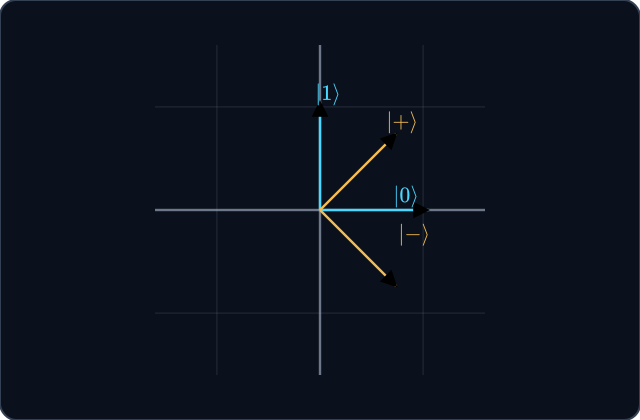
Two orthonormal bases of the same space: and . Each is a complete set of rulers, and any state can be written in either.
Orthonormal bases
A set of vectors is orthonormal when each has length one and any two different ones are orthogonal. It is a basis when every vector of the space is a combination of them; in a space of dimension , any orthonormal vectors are a basis. Completeness is written with ket-bras: the operator sends to , its component along .
Working with a basis
- , the Kronecker delta, is 1 when and 0 otherwise.
- is the identity operator, which leaves every vector unchanged. The completeness relation says that summing the parts of a vector along each basis state gives the whole vector back.
The completeness relation
Expand an arbitrary vector in the basis and find each coefficient by taking a bracket with the corresponding basis bra. Put the coefficients back into the expansion: the vector reappears as the sum of ket-bras acting on it. Since that holds for every vector, the sum is the identity.
Proof steps
Any vector is a combination of the basis vectors, because they form a basis.
Taking the bracket with picks out one coefficient, because the basis is orthonormal.
Substitute back into the expansion.
Read as the ket-bra acting on .
An operator that leaves every vector unchanged is the identity.
Applications
Practice
A Second Basis
The states plus and minus are built from 0 and 1 with a relative sign between them. They are normalised and orthogonal.
Try it
With , what is ?
How Many Basis Vectors
An orthonormal basis of a space of dimension has exactly vectors: fewer cannot build every vector, more cannot all be orthogonal.
Try it
How many vectors does an orthonormal basis of contain?
Completeness
The ket-bra of a basis state picks out a vector’s component along that state. Adding the components along every basis state rebuilds the vector: the sum of the ket-bras is the identity.
Try it
What does the completeness relation say?
Changing Basis
To write a state in a new basis, find its bracket with each new basis bra. Those brackets are the new coefficients.
Try it
Written in the basis , what is the coefficient of in ? Give three decimal places.
Try it
In , any three orthonormal vectors form a basis.
Try it
Inserting the completeness relation of a basis into gives which expression?
Try it
is written in the basis . What is the probability of finding if the question asked is plus or minus?
Final checkpoint
Try it
A state space of dimension two has exactly one orthonormal basis.
Try it
, with . What is the coefficient of in ?
Try it
For an orthonormal basis, what is ?
Completion
Lesson complete
Great work! You now know how to:
- check that a set of states is orthonormal
- use the completeness relation to insert the identity anywhere
- change a state from one basis to another with brackets