Intuition
An atom that jumps from a higher level to a lower one emits a photon carrying the difference. Hydrogen’s levels crowd together under zero like the rungs of a ladder that narrows as it rises, so its lines come in series, one for each lower level: ultraviolet lines ending on , the visible Balmer lines ending on , infrared ones on . Each series crowds towards a limit, the energy needed to free the electron from that level.
A staircase whose steps get shorter and shorter towards a landing: jumping down from any step to the second one gives a family of drops that get closer together, towards the height of the whole flight.
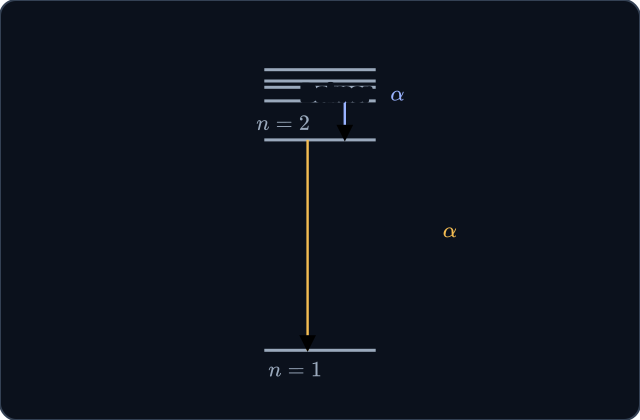
Hydrogen’s levels , crowding towards zero, the dashed line, where the electron is free. The drop from to emits the ultraviolet Lyman line at 122 nm; from to , the red Balmer line at 656 nm.
Lines and series
A transition from level to level emits a photon of energy . Written as a wavelength, this is the Rydberg formula.
The series
- Lyman, : ultraviolet, from 122 nm down to the limit at 91 nm.
- Balmer, : visible, 656 nm (red), 486, 434, 410 nm, down to 365 nm.
The Rydberg formula
The photon carries off the difference between the two levels, and a photon’s energy is . Divide by .
Proof steps
The spectrum from the previous lesson.
Energy is conserved: the photon takes the difference, for .
Subtract the two levels.
Divide by ; is the Rydberg constant.
Each series ends at a limit, set by the energy to free the electron from .
Applications
Practice
Photons From Jumps
A jump from level down to emits a photon carrying the difference of the energies. With , is about 1240 eV nm.
Try it
Using eV and eV nm, what is the wavelength of the line of hydrogen, in nm? Give the nearest whole number.
Series by Their Lower Level
Lines ending on form the ultraviolet Lyman series, those ending on the visible Balmer series, those ending on the infrared Paschen series.
Try it
Which series contains the visible lines of hydrogen?
Ionisation
Freeing the electron from level takes : the whole binding of that level.
Try it
How much energy, in eV, frees the electron from hydrogen’s level?
Crowding Towards a Limit
The levels crowd together towards zero energy, so each series of lines crowds towards a shortest wavelength, its limit.
Try it
The lines of each series get further apart at shorter wavelengths.
Try it
Using eV and eV nm, what is the wavelength of Lyman , the line, in nm? Give the nearest whole number.
Try it
A hydrogen atom in its ground state is hit by a photon of 5 eV. What happens?
Try it
Using eV and eV nm, what is the shortest wavelength of the Balmer series, in nm? Give the nearest whole number.
Final checkpoint
Try it
What is the photon energy of the line of hydrogen, in eV? Give two decimal places.
Try it
Which transition emits the photon of highest energy?
Try it
Deuterium’s spectral lines are at very slightly shorter wavelengths than hydrogen’s.
Completion
Lesson complete
Great work! You now know how to:
- derive the Rydberg formula from the energy levels
- compute wavelengths of the Lyman and Balmer lines
- find series limits and ionisation energies