Intuition
Solve the radial equation with the Coulomb potential and something remarkable happens. Near the origin the solution goes as , far away it must decay as , and in between it is a polynomial times these — but only if the power series in between stops. For most energies it does not, and its tail grows like , which no bound state can do. The series stops only when is for a whole number , and that is the whole spectrum: .
Tuning a guitar string by ear, you hear a clean note only at certain tensions; in between, the sound is wrong. Integrating the radial equation outwards, you find a clean decaying solution only at certain energies; in between, it runs away.
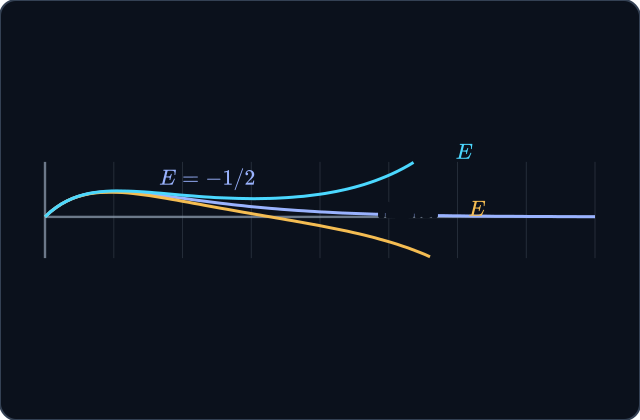
The radial equation of hydrogen integrated outwards from the origin, in atomic units, at three energies. At exactly hartree the solution decays. A little above or below, it swings away to : no bound state there.
The Coulomb radial equation
In atomic units, with for a bound state, peel off the behaviour at the origin and at infinity and expand the rest as a power series. Normalisability forces the series to be a polynomial.
What comes out
- The series stops after terms only if with , a whole number at least .
Only whole numbers stop the series
Substituting the peeled form gives a two-term recursion for the coefficients. If it never stops, the ratio of successive coefficients approaches , the ratio for , and grows like . So some coefficient must vanish, which happens only when for a whole .
Proof steps
The radial equation in atomic units, for a bound state.
Take out the behaviour at the origin and at infinity.
Substitute and collect each power of .
A series that never stops grows like an exponential: not normalisable.
The series stops at exactly when the bracket vanishes there.
Applications
Practice
The Levels
The bound states of hydrogen have energies , with a whole number from 1 up.
Try it
What is the energy of hydrogen’s level, in eV? Give two decimal places.
The Series Must Stop
Between the origin and infinity the solution is a power series. If it never stops, it grows like , and the state cannot be normalised. Only special energies stop it.
Try it
Why are hydrogen’s energies discrete?
The Principal Quantum Number
The series stops after terms, and the energy depends only on , the principal quantum number.
Try it
A state of hydrogen has and . What is ?
\ell Below n
Since with at least zero, the orbital quantum number is at most .
Try it
Hydrogen has a state with and .
Try it
For and , the recursion gives . What is ?
Try it
What does do at large when the series does not stop?
Try it
How many radial nodes does the 3s state of hydrogen have?
Final checkpoint
Try it
In atomic units, what is the decay rate of the states?
Try it
Which radial function belongs to the state , , in atomic units?
Try it
The Schrödinger solution of hydrogen describes the electron moving on circular orbits.
Completion
Lesson complete
Great work! You now know how to:
- peel the radial function and derive the recursion
- show why only gives a normalisable state
- relate , and the number of radial nodes