Intuition
An electron bound to a proton by the Coulomb force is the problem that made quantum mechanics believable: its answer matched a spectrum measured to many decimal places. Before solving it, find its scales. Squeezing the electron into a radius costs kinetic energy of order , and the attraction gains ; the balance falls at the Bohr radius, 0.053 nm, with an energy of eV. In units built from these — atomic units — every hydrogen formula loses its constants.
A cat curls up just tight enough to stay warm and no tighter. The electron settles at the size where pulling in further would cost more kinetic energy than the attraction repays.
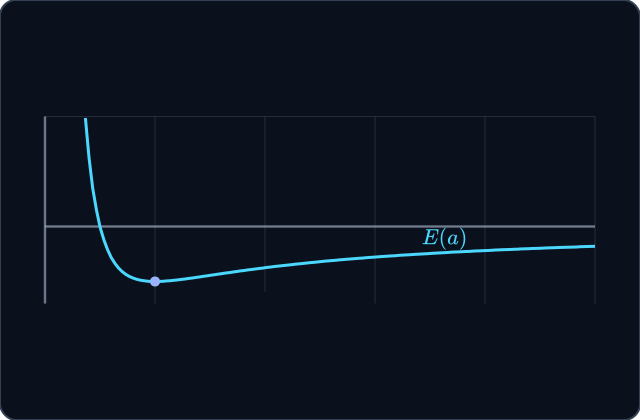
The energy of an electron confined to a size , in atomic units. Squeezing it raises the kinetic term; spreading it weakens the attraction. The minimum is at with hartree, eV.
The Coulomb problem and its units
An electron of mass in the field of a proton, taken as fixed. The constants , and fix a length and an energy, and measured in those every formula is a pure number.
Atomic units
- Atomic units set : lengths are measured in Bohr radii and energies in hartrees .
An estimate that is exact
A state of size has momentum spread about , so kinetic energy about , and potential energy about with . Minimising the sum over gives the Bohr radius and eV. That this rough estimate lands exactly on the true ground state is a lucky feature of the Coulomb potential, confirmed by the exact solution.
Proof steps
Kinetic energy from a momentum of about , potential energy at distance about .
The minimum.
The Bohr radius.
At the minimum the kinetic term is half the potential one in size.
Exactly the ground-state energy the full solution will give.
Applications
Practice
The Bohr Radius
The natural size of the hydrogen atom is the Bohr radius, about 0.053 nanometres, where kinetic and potential energy balance.
Try it
How many Bohr radii make one nanometre? Give the nearest whole number.
The Hartree
The atomic unit of energy, the hartree, is about 27.2 eV. The ground state of hydrogen lies half a hartree below zero.
Try it
What is the ground-state energy of hydrogen in hartrees?
A Balance of Two Energies
Confining the electron to a size costs kinetic energy of about , and the attraction gains about . The atom settles where their sum is least.
Try it
What sets the size of the hydrogen atom?
The Fine-Structure Constant
The dimensionless number , about , measures the strength of electromagnetism. The electron in hydrogen moves at about times the speed of light.
Try it
The electron in hydrogen’s ground state moves at a sizeable fraction of the speed of light, so relativity is essential.
Try it
What is the Rydberg energy, , in eV, to one decimal place?
Try it
What is the hydrogen Hamiltonian in atomic units?
Try it
With and m/s, about how fast does the electron move in hydrogen, in units of m/s? Give two decimal places.
Final checkpoint
Try it
In atomic units, at what is smallest?
Try it
Which constants are set to one in atomic units?
Try it
Using the reduced mass of electron and proton instead of the electron mass changes hydrogen’s energies by about 0.05 per cent.
Completion
Lesson complete
Great work! You now know how to:
- find the Bohr radius and ground energy from a balance of energies
- work in atomic units
- estimate the electron’s speed with the fine-structure constant