Intuition
A hydrogen state is a radial function times a spherical harmonic, and its probability density is a cloud in space. s orbitals are spherical; p orbitals are two lobes on either side of a nodal plane; d orbitals have four lobes or two lobes and a ring. Chemists draw the real combinations — , , — because they point along axes and form bonds, while physicists often use the states of definite . Each orbital has nodal surfaces in all: spheres from the radial part and from the angular part.
A standing wave on a drum has lines where the skin does not move; an orbital has surfaces where the electron is never found. Counting them is counting the wave’s wiggles in each direction.
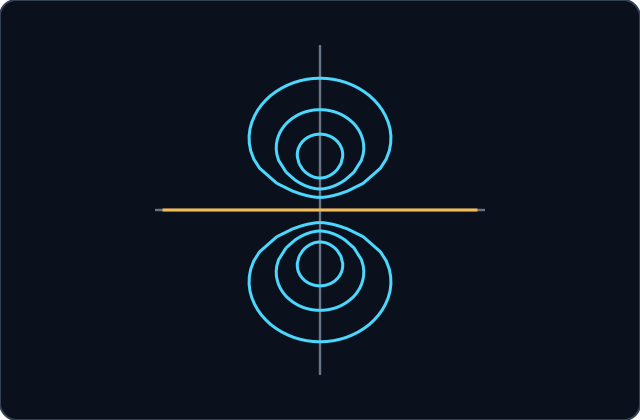
Contours of the density of the orbital in a plane containing the axis, which points up, with lengths in Bohr radii: two lobes, densest at above and below the nucleus, and a nodal plane between them where the electron is never found.
Orbitals
A hydrogen orbital is . Real combinations of , and of , give orbitals that point along axes.
Properties
- , and are , and times : the same shape pointing along three axes.
Counting nodal surfaces
A product vanishes where either factor does. The radial function vanishes on spheres. A spherical harmonic of order vanishes on planes and cones through the nucleus, a property of the Legendre functions used here without proof. Together they make .
Proof steps
A product vanishes where one of its factors does.
The polynomial of degree has that many positive roots.
cones of constant and planes of constant for the real orbitals — quoted from the theory of Legendre functions.
The total depends only on .
Applications
Practice
Nodal Surfaces
An orbital has radial nodal spheres and angular nodal surfaces: in all.
Try it
How many nodal surfaces does a 3p orbital have in total?
The p Orbitals
The orbitals , and are , and times the same radial factor. Each has a nodal plane through the nucleus at right angles to its axis.
Try it
Which plane is the nodal plane of ?
Real Orbitals
The real orbitals and are combinations of and , so they have no definite .
Try it
The orbital is an eigenstate of .
Spheres and Planes
The radial nodes are spheres around the nucleus; the angular ones are planes or cones through it.
Try it
How many nodal spheres does a 5d orbital have?
Try it
What shape is the density of any s orbital?
Try it
How many angular nodal surfaces does an f orbital have?
Try it
Adding the densities of , and gives a spherically symmetric result.
Final checkpoint
Try it
How many nodal surfaces does a 4s orbital have?
Try it
Along the axis, where is the density largest?
Try it
The p block of the periodic table is six elements wide because a p subshell holds three orbitals of two electrons each.
Completion
Lesson complete
Great work! You now know how to:
- build orbitals from radial functions and spherical harmonics
- count radial and angular nodal surfaces
- relate real orbitals to states of definite