Intuition
In a general central potential the energy depends on and separately. In hydrogen it depends only on their sum: 2s and 2p have exactly the same energy, and so do 3s, 3p and 3d. Rotations explain why the values of share a level; they do not explain why different do. Hydrogen has an extra conserved quantity, the Runge–Lenz vector, the quantum version of the fact that a planet’s orbit does not precess, and its hidden symmetry makes each level hold states.
Keplerian orbits of the same energy all have the same long axis, whether round or thin: the thin and round ones are equally cheap. Hydrogen’s values are its round and thin orbits, and they cost the same.
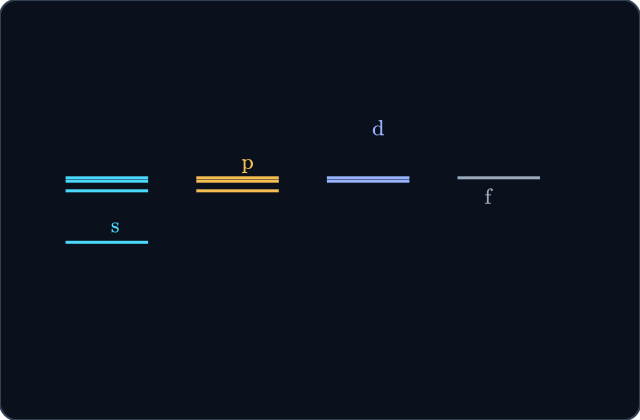
Hydrogen’s levels for to 4 in columns by , in units of 13.6 eV. Levels of the same sit at exactly the same height across the columns: 2s with 2p, 3s with 3p and 3d. In a general central potential they would all differ.
The degeneracy of hydrogen
For each , runs from 0 to and from to , all with the same energy. The count is — twice that when the electron’s spin is included, as a later chapter does.
Where it comes from
- The values of are forced by rotations, as in every central potential.
- The equality of different is forced by a further conserved vector, the Runge–Lenz vector , which commutes with but not with .
Each level holds n^{2} states
Each contributes its values of . Adding over from 0 to is adding the first odd numbers, which make a square.
Proof steps
All for each allowed share the energy .
Split the sum.
The sum of the first whole numbers.
The first odd numbers add to .
Applications
Practice
n^{2} States
Level of hydrogen holds every from 0 to , each with its values of : states in all, leaving spin aside.
Try it
How many states share hydrogen’s level?
Different \ell, Same Energy
In hydrogen the energy depends on alone, so 2s and 2p, or 3s, 3p and 3d, have exactly the same energy. In a general central potential they would differ.
Try it
Which pair of hydrogen states has the same energy?
More Than Rotations
Rotations force the values of to share an energy. The sharing between different needs a further symmetry, carried by the Runge–Lenz vector.
Try it
Rotational symmetry alone explains why 2s and 2p have the same energy in hydrogen.
Counting Quickly
The first odd numbers add to , so no sum needs doing: level holds states.
Try it
How many states share hydrogen’s level?
Try it
What does the classical Runge–Lenz vector of a Kepler orbit point to?
Try it
How many of hydrogen’s states have ?
Try it
In a sodium atom, whose outer electron feels a potential that is not a pure , the 3s and 3p levels have different energies.
Final checkpoint
Try it
In a many-electron atom each state holds at most two electrons. How many electrons fill the whole shell with ?
Try it
Which values of belong to hydrogen’s level?
Try it
What is ?
Completion
Lesson complete
Great work! You now know how to:
- count the states of a hydrogen level
- separate the degeneracy rotations explain from the one they do not
- name the hidden symmetry behind it