Intuition
The radial functions of hydrogen are polynomials times decaying exponentials. The most telling picture is not itself but the radial probability density , the chance of finding the electron at distance in any direction. For 1s it peaks at exactly the Bohr radius; 2s has an inner bump and a node before its main peak; 2p, with no node, peaks at four Bohr radii. The higher , the further out the electron lives, roughly as .
A population map shows people per square kilometre; a map of how many live at each distance from a city centre must multiply by the ring’s area. The radial density does that, multiplying by for the shell at each radius.
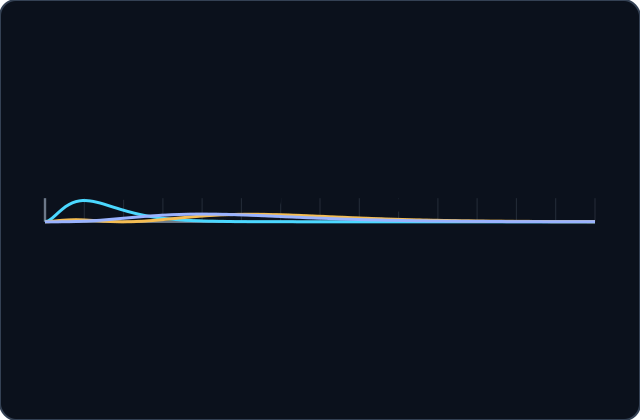
Radial probability densities of the 1s, 2s and 2p states against in Bohr radii. 1s peaks at ; 2s has a small inner bump, a node at and its main peak further out; 2p peaks at .
The first radial functions
In units of the Bohr radius, is a polynomial of degree times , normalised with .
Properties
- The radial density is the probability per unit distance of finding the electron at distance .
- has nodes; 2s has one, at .
The most probable radius of 1s
The radial density is , which grows, times a decaying exponential. Its derivative is zero where the growth of exactly balances the decay, which is at one Bohr radius.
Proof steps
Square the radial function and multiply by .
Product rule.
The nonzero root.
A maximum, since vanishes at and at infinity.
Applications
Practice
Radial Density
The probability of finding the electron between and in any direction is . For 1s it peaks at one Bohr radius.
Try it
At what , in Bohr radii, does the 2p radial density peak?
Radial Nodes
The radial function has nodes. The 2s function changes sign at two Bohr radii.
Try it
Where is the radial node of hydrogen’s 2s state?
Who Reaches the Nucleus
Only s states, with , have a nonzero wavefunction at the nucleus; every other state vanishes there as to the .
Try it
A 2p electron has a nonzero probability density at the nucleus.
Probability Within a Radius
The probability of finding the electron within a radius is the integral of the radial density up to it.
Try it
The probability of finding a 1s electron within one Bohr radius is . What is it? Give three decimal places.
Try it
How many radial nodes does the 4d state have?
Try it
How does decay at large ?
Try it
for every hydrogen state.
Final checkpoint
Try it
At what radius, in Bohr radii, does the 3d radial density peak?
Try it
Why does the 2s radial density have a small bump close to the nucleus?
Try it
In atomic units . What is it to three decimal places?
Completion
Lesson complete
Great work! You now know how to:
- write the first radial functions and their nodes
- find the most probable radius from the radial density
- explain which states reach the nucleus