Intuition
Strip an atom of all but one electron and it is hydrogen again, with a nucleus of charge . Nothing needs solving afresh: replace by and every result scales. The energies grow as , the sizes shrink as . Helium with one electron is bound four times as strongly as hydrogen, uranium with one electron some eight thousand times. Changing the orbiting particle instead — a muon, or a positron’s partner — changes the reduced mass and scales everything again.
A stronger magnet pulls a steel ball closer and holds it harder. A nucleus of higher charge does both to its electron: closer by a factor , harder by a factor .
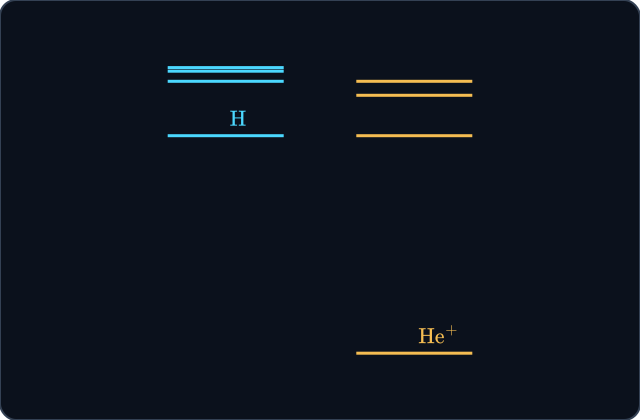
The levels to 4 of hydrogen and of the helium ion He on one energy scale, in units of 13.6 eV. Every He level is four times deeper: eV for its ground state against . Its level coincides with hydrogen’s ground state.
Scaling with charge and mass
For a nucleus of charge and an orbiting particle of reduced mass , the hydrogen results scale with and with .
Examples
- He (): ground state eV, size . Li (): eV.
The scaling with Z
Every hydrogen formula depends on the strength of the attraction. A charge multiplies it by . Lengths go as , so they shrink by ; energies go as , so they grow by .
Proof steps
The nucleus has charge instead of .
The Bohr radius depends on as .
The energies depend on .
The same formulas give the dependence on the reduced mass.
Applications
Practice
Energies as Z^{2}
A one-electron ion with nuclear charge has energies times hydrogen’s.
Try it
What is the ground-state energy of Li (), in eV? Give one decimal place.
Sizes as 1/Z
A stronger nucleus pulls the electron in: the natural size shrinks as .
Try it
How big is the ground state of He compared with hydrogen’s?
Levels That Coincide
level has energy eV, so its level sits at eV, exactly hydrogen’s ground energy.
Try it
The level of He has the same energy as the ground state of hydrogen, ignoring the reduced mass.
Heavier Orbiters
Replacing the electron by a heavier particle multiplies the energies by the ratio of reduced masses and shrinks the sizes by the same ratio.
Try it
Muonic hydrogen has a reduced mass of about . About how much is its ground state bound, in keV? Give two decimal places.
Try it
Using eV nm, what is the wavelength of the line of He, in nm? Give one decimal place.
Try it
How does positronium’s ground state compare with hydrogen’s?
Try it
In a one-electron ion of uranium, , the ground-state electron moves at more than half the speed of light.
Final checkpoint
Try it
What is the size scale of Li, in nm? Give four decimal places.
Try it
Why do the innermost X-ray lines of the elements scale roughly as ?
Try it
By what factor is the ground state of He more deeply bound than that of hydrogen?
Completion
Lesson complete
Great work! You now know how to:
- scale hydrogen’s results with the nuclear charge
- scale them with the reduced mass for exotic atoms
- compute levels and lines of one-electron ions