Intuition
Averages tell what a measurement on many atoms would find. The mean distance of a 1s electron is one and a half Bohr radii, more than the most probable distance because the tail reaches far. The mean potential energy is exactly twice the total energy, and the mean kinetic energy exactly minus it: the virial theorem of the Coulomb force, the same balance as for planets. So a hydrogen atom in its ground state has 13.6 eV of kinetic energy and eV of potential energy.
The most common income in a country is less than the average income, because a long tail of large incomes pulls the average up. The 1s density has such a tail, and its mean radius lies beyond its peak.
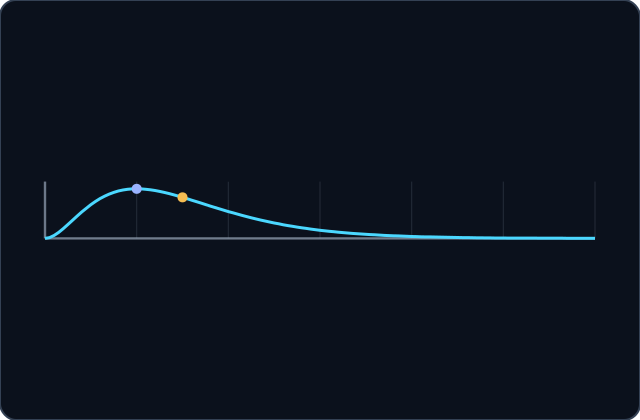
The 1s radial density in Bohr radii, with its peak at and its mean . The long tail pulls the mean beyond the most likely distance.
Averages in hydrogen
Radial averages are integrals of powers of against the radial density. Closed forms exist for every state.
Properties
- The virial theorem for : and .
The mean radius of 1s
Weight each radius by the radial density and integrate. With the integral becomes a factorial integral, .
Proof steps
The average of against the radial density.
Change the variable.
The factorial integral of the Analysis course.
Multiply out.
Applications
Practice
The Mean Radius
The mean distance of the electron is the integral of times the radial density. For hydrogen’s states it has a closed form.
Try it
What is for the 2p state, in Bohr radii?
The Virial Theorem
For the Coulomb potential the average kinetic energy is minus the total energy, and the average potential energy is twice it.
Try it
What is the mean kinetic energy of hydrogen’s ground state, in eV? Give one decimal place.
Potential Energy
The mean potential energy of a Coulomb state is twice its total energy.
Try it
What is in hydrogen’s states?
Mean Beyond the Peak
The 1s density has a long tail towards large , so its mean distance, 1.5 , lies beyond its most probable distance, .
Try it
For 1s, the mean distance equals the most probable distance .
Try it
What is for , in units of ? Give three decimal places.
Try it
Which state has the smallest ?
Try it
About how many times larger is for the 10s state than for 1s? Use for states.
Final checkpoint
Try it
In atomic units, . For the ground state, what is in hartrees?
Try it
Which relation holds in every bound state of hydrogen?
Try it
What is for the 3p state, in Bohr radii?
Completion
Lesson complete
Great work! You now know how to:
- compute and for hydrogen states
- use the virial theorem to split the energy
- explain why the mean radius exceeds the most probable one