Intuition
A condition earns its name by what it lets you prove. The Hausdorff property is what makes a limit unique: without it a sequence can settle on two points at once, and "the limit" is not a phrase that means anything. In the cofinite topology every sequence of distinct points converges to every point of the space at the same time, which is exactly how bad it gets.
If two towns can always be given separate districts, a traveller who ends up arbitrarily close to both has to be in one of them. If the districts always overlap, being near one is no evidence of not being near the other.
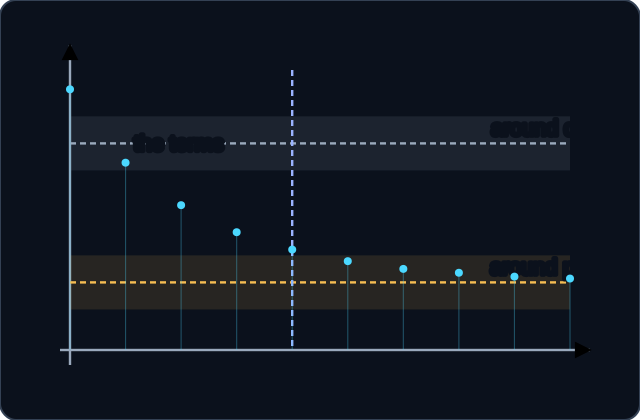
Two candidate limits with disjoint bands around them. Convergence to puts every term beyond some index inside the first band; convergence to would put every term beyond some index inside the second. Past the later of the two indices a term would have to be in both bands, and the bands share nothing — so in a Hausdorff space a sequence has at most one limit.
What the condition buys
In a Hausdorff space a convergent sequence has exactly one limit, so writing names a point rather than a possibility. The proof is the definition used twice, and it is the model for every later use of the property: take the two disjoint open sets and derive something that cannot be in both.
What follows, and what fails without it
- In the cofinite topology on an infinite set, a sequence of distinct points converges to every point at once: any open set around any point misses only finitely many terms. Limits are not unique, and the space is not Hausdorff.
- In an indiscrete space every sequence converges to every point, for the same reason with no work at all.
- A space is Hausdorff exactly when the diagonal is closed in the product. Stated here as a second face of the same condition; the argument is a short one about basic boxes and is left to a later course.
- Two continuous maps into a Hausdorff space that agree on a dense subset agree everywhere. This is the reason uniqueness of limits matters in practice: a function is pinned down by its values on the rationals.
- The next lesson is the other use worth learning: in a Hausdorff space, a compact subset is closed.
Limits are unique in a Hausdorff space
Suppose a sequence converged to two different points. The space is Hausdorff, so those two points have disjoint open sets around them. Convergence to the first means that beyond some index every term is in the first set; convergence to the second means that beyond some other index every term is in the second. Take an index beyond both. The term there lies in both open sets at once, and the two share no point. That is impossible, so the two points cannot have been different.
Proof steps
Suppose the sequence converged to two distinct points.
The Hausdorff property supplies disjoint open sets around them.
Each convergence puts a whole tail of the sequence inside its own set.
Beyond both indices a term lies in both sets at once.
The two sets share nothing, so the assumption fails and the limits coincide.
Applications
:::note{title="Writing "the limit""} Analysis speaks of the limit of a sequence, the value of a derivative, the sum of a series. Each is a limit, and each is well defined because the spaces involved are Hausdorff. :::
Practice
One Limit, Not Two
Disjoint open sets around two candidate limits cannot both hold a whole tail of the same sequence.
Try it
What does the Hausdorff property give a convergent sequence?
Try it
In the cofinite topology on an infinite set, what does a sequence of distinct points converge to?
Try it
is enough to make limits unique.
Try it
In the uniqueness proof, where is the Hausdorff property used?
Try it
Two continuous maps into a Hausdorff space that agree on a dense subset agree everywhere.
Try it
A sequence in a Hausdorff space converges. How many limits can it have?
Try it
In an indiscrete space with three points, which points is the constant sequence a convergent sequence to?
What You Learned
- In a Hausdorff space a convergent sequence has exactly one limit.
- The proof takes disjoint sets around the two candidates and finds a term in both.
- Without it limits multiply: in the cofinite topology every sequence of distinct points converges everywhere.
- The property is what makes the phrase "the limit" mean anything.
Final checkpoint
Try it
A space is not Hausdorff. Which of these may go wrong?
Try it
In any topological space, a sequence has at most one limit.
Completion
Lesson complete
Great work! You now know how to:
- prove that limits are unique in a Hausdorff space;
- see limits multiply in a space that is not;
- name the step of the proof that uses the property;
- recognise where the condition is quietly assumed elsewhere.