Intuition
The last rung replaces both points with closed sets: two disjoint closed sets should have disjoint open sets around them. This is normality, and it is the condition under which continuous functions can be built where none were given — the content of Urysohn's lemma, which this course names and leaves to a later one. Normality is also the rung that behaves worst: unlike the others it is not inherited by subspaces.
Separating two individuals is one thing, an individual from a crowd another, and two crowds a third. Each demand costs more, and the last one is the one that stops being automatic.
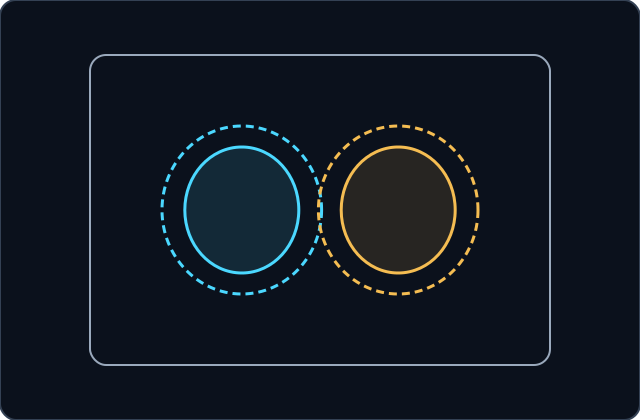
Normality: two disjoint closed sets, each inside an open set, and the two open sets share no point. In a metric space the two open sets are built from one function — the points closer to than to , and the points closer to than to .
Two closed sets apart
A space is normal when any two disjoint closed sets and lie in disjoint open sets. Normal together with is called . With the points are closed, so implies implies — and without normality alone implies nothing at all about points.
Which spaces are normal, and what breaks
- Every metric space is normal, which the theorem below proves from the distance to a set. That the distance to a set is continuous is taken on trust here; it belongs to the analysis course.
- Every compact Hausdorff space is normal: both closed sets are compact, and the separation of a point from a compact set is applied twice.
- Normality is not inherited by subspaces, and a product of normal spaces need not be normal — the Sorgenfrey plane is the standard example. Both failures are stated here and not built; every other rung of the ladder is inherited and does survive products.
- Urysohn's lemma: in a normal space, two disjoint closed sets are the zero set and the one set of a continuous function into . Named here, and the proof belongs to a later course.
- The lemma is the reason the rung matters: it turns a separation property into an actual function, and functions are what later theorems are built from.
Every metric space is normal
Take two disjoint closed sets in a metric space and measure, for each point, its distance to each of them. Distance to a closed set is zero exactly at the points of the set, so a point of the first set has distance zero to the first and positive distance to the second, and the other way round. Now take the points strictly closer to the first set and the points strictly closer to the second. These two sets contain the two closed sets respectively, they share no point, since no number is strictly less than itself, and each is open because both distances vary continuously — which this course takes on trust.
Proof steps
Measure each point against each of the two sets.
For a closed set, distance zero means membership, which is where closedness is used.
Take the points strictly closer to one set than to the other.
A point of the first set has distance zero to it and positive distance to the other.
No point is strictly closer to each than to the other, so the two open sets miss each other.
Applications
Practice
Two Crowds, Two Rooms
Normality separates two disjoint closed sets by disjoint open sets.
Try it
What does normality ask for?
Try it
Which pair of sets separates two disjoint closed sets in a metric space?
Try it
In a metric space, exactly when , for closed.
Try it
Every subspace of a normal space is normal.
Try it
Every compact Hausdorff space is normal.
Try it
Counting , , , and , how many rungs of the ladder does a metric space satisfy?
Try it
What does Urysohn's lemma produce in a normal space?
What You Learned
- Normality separates two disjoint closed sets by disjoint open sets.
- Metric spaces and compact Hausdorff spaces are normal.
- Normality is not inherited by subspaces and does not survive products.
- Urysohn's lemma turns the separation into a continuous function.
Final checkpoint
Try it
A space is , that is normal and . Which of these does not follow?
Try it
Normality on its own implies the Hausdorff property.
Completion
Lesson complete
Great work! You now know how to:
- state normality and place it at the top of the ladder;
- prove that a metric space is normal, from the distance to a set;
- name the two failures that make this rung different;
- say what Urysohn's lemma provides.