Intuition
The compactness chapter left a gap: a compact subset need not be closed, and the Sierpiński space showed it. The missing hypothesis is the Hausdorff property, and with it the implication holds in every space, not only in metric ones. The proof is the same shape as the metric one, with disjoint open sets in place of balls of half the distance.
The metric proof shrank distances by half. Without a metric there is nothing to halve, so the Hausdorff property is asked to hand over the room directly — and finiteness of the cover is what turns a room for each point into one room for all of them.
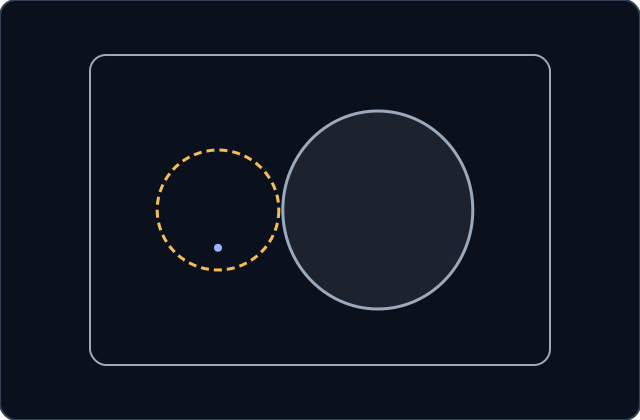
A point outside a compact set. For each point of the Hausdorff property gives a pair of disjoint open sets, one around that point and one around ; finitely many of the first kind already cover , and the intersection of the matching finitely many of the second kind is an open set around missing all of them. So the complement of is open.
Compact plus Hausdorff
In a Hausdorff space every compact subset is closed. The converse of that — a closed subset of a compact space is compact — was proved without any separation axiom in the compactness chapter, so in a compact Hausdorff space the two words describe the same subsets.
What the pair of hypotheses gives
- In a compact Hausdorff space, compact and closed are the same property, since each implication holds. That is the setting where the word "compact" can be used without care.
- An intersection of two compact subsets of a Hausdorff space is compact: both are closed, so the intersection is a closed subset of a compact set. In a general space this fails, as the compactness chapter warned.
- A continuous bijection from a compact space to a Hausdorff space is a homeomorphism. The inverse is continuous because the map sends closed sets to closed sets: a closed subset of the source is compact, its image is compact, and a compact subset of the target is closed.
- Compact subsets of a Hausdorff space can be separated from a point by disjoint open sets, which is the content of the proof below and a step towards the regularity of the next lesson.
- Without the Hausdorff property the statement is false: in the Sierpiński space is compact and not closed.
A compact subset of a Hausdorff space is closed
Take a point outside the compact set. For each point of the set the Hausdorff property gives two disjoint open sets, one around that point and one around the chosen outside point. The first kind cover the set, so compactness keeps finitely many of them that still do. Now intersect the matching finitely many sets around the outside point: a finite intersection of open sets is open, it holds the chosen point, and it misses every one of the finitely many sets that cover the compact set — so it misses the set entirely. Every point outside therefore has an open set around it inside the complement, which is what open means.
Proof steps
For each point of the compact set, separate it from the outside point.
The sets around the points of the compact set cover it.
Compactness thins that cover to finitely many.
The matching sets around the outside point are finitely many, so their intersection is open.
That intersection misses each of the finitely many covering sets, hence the whole compact set.
Applications
Practice
Compact Becomes Closed
In a Hausdorff space compactness implies closedness; the compactness chapter proved the converse inside a compact space.
Try it
is a compact subset of a Hausdorff space. What follows?
Try it
In the proof, what is compactness used for?
Try it
Closedness of a compact subset needs no assumption about the space around it.
Try it
An intersection of two compact subsets of a Hausdorff space is compact.
Try it
is a continuous bijection, is compact and is Hausdorff. What follows?
Try it
How many of the two hypotheses — compact and Hausdorff — can be dropped and still leave the theorem true?
Try it
In a compact Hausdorff space, closed and compact describe the same subsets.
What You Learned
- In a Hausdorff space every compact subset is closed.
- The proof separates each point of the set from the outside point, then thins.
- Compactness is spent on making the intersection finite, so it stays open.
- A continuous bijection from a compact space to a Hausdorff space is a homeomorphism.
Final checkpoint
Try it
is compact and not closed. What follows about ?
Try it
In a metric space, a compact subset is closed.
Completion
Lesson complete
Great work! You now know how to:
- prove that a compact subset of a Hausdorff space is closed;
- say where compactness and where the Hausdorff property are used;
- use compact and closed interchangeably in a compact Hausdorff space;
- recognise a continuous bijection that is automatically a homeomorphism.