Intuition
Everything so far has been stated in open sets, and open sets can be very coarse: in the indiscrete topology no open set distinguishes one point from another, so the space cannot see its own points. The separation axioms are a ladder of demands, each asking the open sets to tell more apart. The first two rungs ask about points only, and the second of them turns out to be the same thing as every single point being closed.
A register that lists everyone as "a resident" tells nobody apart. One that gives each person a street tells some apart; one that gives each an address tells all of them apart. Nothing about the people changed, only what the register can express.
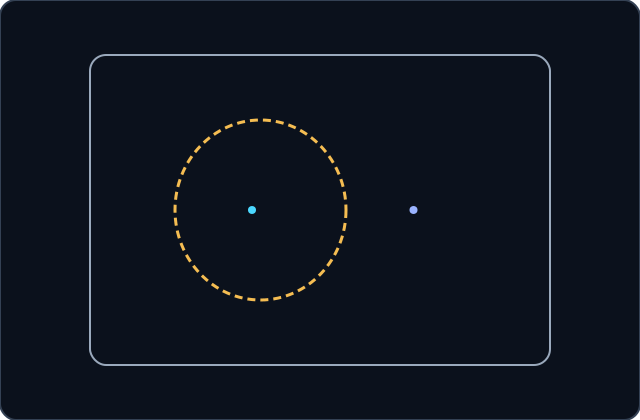
An open set holding and missing . One such set, for one of the two orders, is all that asks. asks for one each way round: an open set holding and missing , and another holding and missing . The difference looks small and decides whether single points are closed.
The first two rungs
A space is when, for any two distinct points, some open set holds one of them and not the other. It is when, for any two distinct points, there is an open set holding the first and missing the second and another holding the second and missing the first. implies , and the converse fails.
Where the spaces sit
- The indiscrete topology on two or more points is not even : the only non-empty open set holds everything.
- The Sierpiński space is and not : the open set tells from , and no open set holds without holding .
T1 means every point is closed
Read each direction at a point. Suppose the space is T1 and take a point; every other point has an open set holding it and missing the chosen one, so the complement of the chosen point is a union of open sets and therefore open, which makes the point closed. Now suppose every point is closed and take two distinct points; the complement of the second is open, it holds the first and misses the second, and the same with the two swapped. That is exactly what T1 asks, so the two conditions say the same thing.
Proof steps
Assume the space is T1 and take a point together with any other.
T1 gives an open set holding the second point and missing the first.
Those open sets unite to the complement of the point, so the complement is open.
A set whose complement is open is closed, which is one direction.
Conversely, if points are closed, the complement of one point is an open set separating it from any other.
Applications
Practice
Two Rungs, One Difference
asks for one open set that tells two points apart; asks for one each way round.
Try it
What does demand of two distinct points?
Try it
The Sierpiński space has open sets , and . Which rung does it reach?
Try it
An indiscrete space with two points is .
Try it
In a space, every one-point subset is closed.
Try it
The cofinite topology on an infinite set has as open sets and the complements of finite sets. Is it ?
Try it
How many topologies on a two-point set are ?
Try it
Why is every metric space ?
What You Learned
- : some open set tells two points apart. : one each way round.
- is the same as every point being closed.
Final checkpoint
Try it
A space has a point whose one-point set is not closed. Which is impossible?
Try it
Every space is .
Completion
Lesson complete
Great work! You now know how to:
- state the first two separation axioms;
- recognise as every point being closed;
- place the Sierpiński, indiscrete, discrete and cofinite spaces on the ladder;
- see why a coarse topology cannot tell its own points apart.