Intuition
The next rung asks for room: two distinct points should have open sets around them that do not meet at all. This is the Hausdorff condition, and it is the one almost every space in analysis and geometry satisfies. It is strictly stronger than the rung below, and the cofinite topology is what shows that.
Two people can be told apart by name, and that is one rung. They can also be given separate rooms with the door shut. The second is the condition under which everything that happens to one of them stays away from the other.
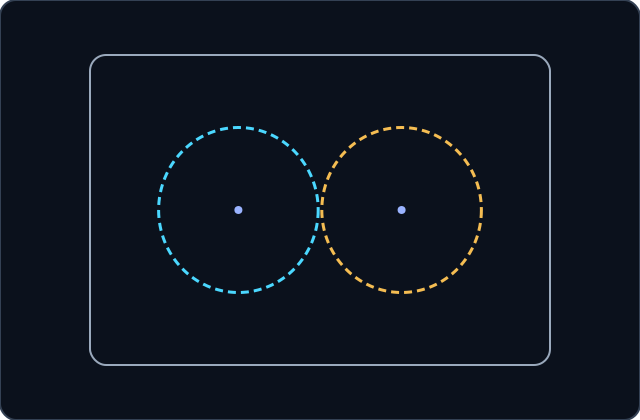
The Hausdorff condition: distinct points and have open sets around them that share no point. In a metric space the two balls of radius do it, and the triangle inequality is the whole reason they miss each other.
Disjoint neighbourhoods
A space is Hausdorff, or , when any two distinct points have disjoint open sets around them: open and with . Hausdorff implies , since holds and misses , and does not imply Hausdorff.
What is Hausdorff and what is not
- Every metric space is Hausdorff, which the theorem below proves with the two balls of radius half the distance.
- The cofinite topology on an infinite set is and not Hausdorff: two non-empty open sets there are complements of finite sets, and two such sets always meet, because the set is infinite.
- A subspace of a Hausdorff space is Hausdorff: intersect the two open sets with the subspace and they are still disjoint.
- A product of two Hausdorff spaces is Hausdorff. Two distinct points of the product differ in some coordinate, and a pair of disjoint open sets there pulls back to a pair of disjoint strips.
- The property is a topological invariant: a homeomorphism carries a disjoint pair to a disjoint pair, so it cannot join a Hausdorff space to one that is not.
Every metric space is Hausdorff
Take two distinct points. Their distance is positive, so half of it is a radius that can be used. Suppose some point lay in both balls. Then its distance to the first point and its distance to the second are each less than half the distance between them, and the triangle inequality says the distance between the two points is at most the sum of those two — which would make that distance less than itself. That is impossible, so no point lies in both balls, and two open sets around the two points have been produced.
Proof steps
Distinct points are a positive distance apart, so half that distance is a usable radius.
Suppose some point lay in both balls.
The triangle inequality bounds the distance between the two points by the two smaller distances.
The right-hand side is the distance itself, so the distance would be less than itself.
No such point exists, so the two balls are disjoint open sets around the two points.
Applications
Practice
Room Around Each Point
Hausdorff asks for open sets around two distinct points that share no point at all.
Try it
What does the Hausdorff condition ask for?
Try it
Every Hausdorff space is .
Try it
Why is the cofinite topology on an infinite set not Hausdorff?
Try it
A subspace of a Hausdorff space is Hausdorff.
Try it
A product of two Hausdorff spaces is Hausdorff.
Try it
In with the usual metric, what is the largest radius for which and are disjoint?
Try it
Which of these spaces is not Hausdorff?
What You Learned
- Hausdorff asks for disjoint open sets around two distinct points.
- Hausdorff implies implies , and neither implication reverses.
- Every metric space is Hausdorff, by the two balls of half the distance.
- Subspaces and finite products of Hausdorff spaces are Hausdorff.
Final checkpoint
Try it
Which chain of implications is correct?
Try it
A space is Hausdorff.
Completion
Lesson complete
Great work! You now know how to:
- state the Hausdorff condition in open sets;
- prove that every metric space is Hausdorff;
- give a space that is T1 and not Hausdorff;
- carry the property to subspaces and products.