Intuition
A topology can be enormous — the open sets of the line are already uncountably many — and yet be described by a countable list. Second countability asks for a countable basis for the whole space, first countability only for a countable basis at each point. Both hold in the spaces this course is built on, and the second is what makes sequences enough to detect closures and continuity.
A language has infinitely many sentences and a finite dictionary. Asking for a countable basis is asking for a dictionary; asking for a countable basis at a point is asking for one per speaker.
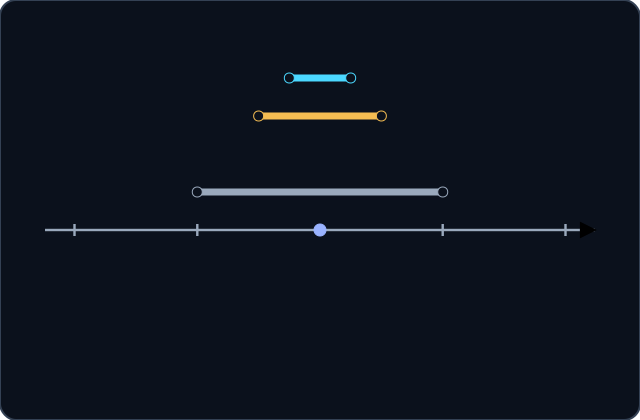
A countable basis at a point of the line: the balls . Every open set around contains one of them, so this countable list describes every neighbourhood of — which is first countability. Second countability asks for one countable list serving the whole space at once, and the intervals with rational endpoints are such a list.
Countable lists that describe a topology
A space is first countable when every point has a countable family of open sets around it such that every open set around the point contains one of them. It is second countable when the topology has a countable basis. Second countable implies first countable, and the converse fails.
Which spaces are countable in which sense
- Every metric space is first countable: the balls are a countable basis at , since any open set around holds a ball and any ball holds one of these.
- is second countable: the intervals with rational endpoints are a basis, and there are countably many of them. is too, by taking boxes with rational corners, which is why the plane behaves as well as the line.
Second countable implies first countable
Take a countable basis for the whole space and a point. Keep the basic sets that contain the point and discard the rest. What is left is a subfamily of a countable family, so it is countable. It is also a basis at the point: any open set around the point is a union of basic sets, and the point lies in one of them, which therefore contains the point and sits inside the open set. So the point has a countable basis around it, which is first countability. Nothing in the argument is about a particular point, so it holds at every point at once.
Proof steps
Start from a countable basis for the whole topology.
Keep the basic sets containing the chosen point.
A subfamily of a countable family is countable.
Every open set around the point is a union of basic sets, and one of them catches the point.
The kept family is a countable basis at the point, and the point was arbitrary.
Applications
Practice
One List for the Whole Space
Second countability asks for a countable basis for the topology; first countability only for one at each point.
Try it
What does second countability ask for?
Try it
Which countable family is a basis for the standard topology on ?
Try it
Every second countable space is first countable.
Try it
Why is every metric space first countable?
Try it
The Sorgenfrey line is second countable.
Try it
How many intervals with rational endpoints , , are there, as a cardinality: for finitely many, for countably many, for uncountably many?
Try it
What does first countability buy?
What You Learned
- Second countable: a countable basis for the topology. First countable: one at each point.
- Second implies first; metric spaces are first countable and the line is second countable.
- Separable means a countable dense subset, and second countable implies separable.
- The Sorgenfrey line is first countable, separable and not second countable.
Final checkpoint
Try it
Which space is second countable?
Try it
Every first countable space is second countable.
Completion
Lesson complete
Great work! You now know how to:
- tell the two countability axioms apart;
- produce a countable basis for the line and for the plane;
- see why metric spaces are first countable;
- name the space that is first countable and not second.